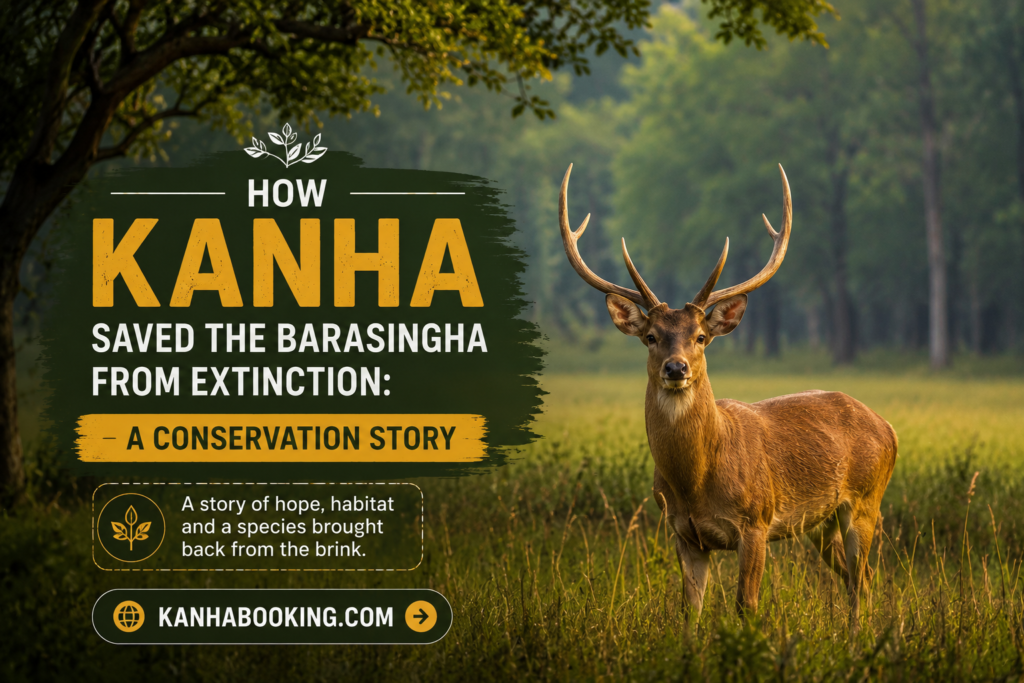
There is a deer in the meadows of Kanha National Park that almost vanished from the earth . Today it grazes freely, antlers catching the morning light, and it’s basically one of India’s proudest wildlife comeback stories. This is the story of the barasingha, the hard ground swamp deer , and how Kanha Tiger Reserve pulled it back from the edge of extinction.
What is Barasingha and why is it so special?
The barasingha (Rucervus duvaucelii branendri) is often called the “twelve-tined deer” because a mature stag’s antlers can carry up to twelve points, sometimes even more. It is the state animal of Madhya Pradesh and, unlike its swamp-dwelling cousins found in Assam and Nepal, the Kanha population is the hard-ground subspecies uniquely adapted to firm meadow soil rather than marshland.
What makes this deer remarkable is exclusivity. Kanha National Park is the only place on the planet where the hard-ground barasingha survives in the wild. Lose it here, and the subspecies is gone forever. That single fact is why its recovery matters so much to global conservation.
The Barasingha’s Brush with Extinction
The story of Kanha’s barasingha is not one of steady decline followed by a quick fix. It is a decades-long crisis. In the early 1950s, an estimated 3,000 barasingha roamed the grasslands of central India. Unchecked hunting, disease, habitat destruction, and the conversion of grasslands into farmland shrank that number dramatically.
In 1970, only 66 Barasinghas were left in Kanha National Park. Fawns were being lost to jackals and other predators before they could grow strong enough to survive independently. Grasslands were disappearing under agricultural encroachment. Forest villages sat inside prime deer habitat, adding pressure on the very meadows the barasingha depended on for food. Extinction was not a distant possibility — it was a real and immediate threat.
How Kanha Turned the Crisis Around
What followed is now studied as a model of species recovery. The Kanha barasingha conservation programme actually began in 1967, even before Project Tiger was formally launched in India in 1973, making it one of the earliest single-species recovery efforts in the country.
Village relocation and grassland restoration. Around 35 forest villages were relocated out of the park’s core area over the years. The land they vacated, once degraded by grazing and farming, was slowly restored into open grassland meadows, or “maidans,” planted with the grasses and aquatic plants the barasingha prefers.
Predator-free breeding enclosures (the Boma system). In 1996–97, forest officials built a 25-hectare predator-free enclosure inside the reserve, releasing eight swamp deer into it to breed safely. As numbers grew, the enclosure was expanded to 50 hectares. This “boma” approach protected vulnerable fawns during their most dangerous early days, when depredation was the single biggest cause of population loss.
Protecting mothers and newborns. Fawning season begins around August and September. During this window, females were kept inside fenced areas so that jackals could not prey on newborn fawns, which take roughly 48 hours after birth to become active and mobile.
Active habitat management. Grasslands were carefully maintained, with woody growth and invasive weeds cleared to keep meadows open and productive. Wildlife corridors, including a well-used six-kilometre stretch near Sondar, were preserved so barasingha herds could move freely between feeding grounds.
Translocation to new homes. As the Kanha population sort of became strong enough , conservationists started this delicate effort of translocating deer to fresh reserves, which is how they reduce the risk of losing the entire subspecies to one single localised disaster, you know. Barasingha has since been shifted to Satpura Tiger Reserve and Bandhavgarh National Park in multiple phases since 2018 , and that has helped set up new geographically separate populations.
The Numbers Behind the Comeback
The results speak pretty clearly. From a low of 66 individuals in 1970, the barasingha count in Kanha went up steadily, as in:
- 1970: around 66 individuals
- 2015: approximately 450
- 2020: around 800
- Recent counts: well over 1,000 individuals across Kanha’s meadows,
This comeback is now seen as one of India’s most successful conservation tales for a single species, ranking right alongside the revival of the Bengal tiger under Project Tiger .
Bhoorsingh: The Mascot Born from a Conservation Success
In 2017, Kanha sort of became the first tiger reserve in India to introduce an official mascot, Bhoorsingh the Barasingha designed by wildlife cartoonist Rohan Chakravarty. The name in itself means “golden antlers”. Instead of going with the tiger, the kinda obvious crowd pleaser, park officials picked the barasingha on purpose , mainly to highlight its amazing comeback tale and create awareness among younger visitors. Life-size cutouts of Bhoorsingh still welcome everyone at the gates and the interpretation centre near Khatia, where a conservation statistic turns into something people actually remember.
Where to Spot Barasingha on a Kanha Safari
Barasingha are usually spotted in the open meadows of the Kanha and Sondar areas, most often during the early morning and late afternoon safari slots when the herd comes out too graze, sort of. They typically travel in single-sex herds, and mixed groups generally include a young male along with his mother. Watching a small group graze in the sunset light, that warm gold spilling over the grasslands, somehow always turns into one of those unforgettable views you just catch during a Kanha jungle safari, right?
If your trip is basically designed around this exact sort of scenery, then booking your Kanha safari online ahead of time feels like the safest move. It helps you lock in a zone and time slot with stronger barasingha viewing chances, because permits are limited and they’re shared only via official channels.
Frequently Asked Questions
Hunting, disease, predation of fawns, and large-scale loss of grassland habitat to farming pushed the population down to just 66 animals by 1970.
Conservation efforts started in 1967, even before Project Tiger was launched in India in 1973.
The population has grown from 66 in 1970 to well over 1,000 individuals today, making it the world’s only wild population of the hard-ground barasingha.
A boma is a predator-free enclosure used to protect breeding barasingha and vulnerable newborn fawns until they are strong enough to survive in the open grasslands.
The hard-ground barasingha is said to occur only in Kanha National Park when it’s in the wild. Other barasingha forms live in Kaziranga, Dudhwa, and in parts of Nepal too, but those are kind of ecologically different populations, not the same.
Early morning and late afternoon safaris in the Kanha and Sondar meadow zones offer the best chances, especially between October and June when the park is open.
Bhoorsingh is Kanha Tiger Reserve’s official mascot, introduced in 2017 to celebrate the barasingha’s recovery from near-extinction and raise conservation awareness among visitors.
Conclusion
Barasingha’s journey from only 66 survivors to a lively population of more than 1,000 feels like one of India’s best wildlife care stories, and in a way it all lives in Kanha National Park. With habitat repair, predator-free breeding enclosures, plus careful grassland handling, this rare hard-ground swamp deer was nudged back from the edge of disappearing, now it moves around freely across Kanha’s meadows. For travellers trying to spot this unusual species up close, a well timed Kanha safari booking gives the strongest shot to see barasingha grazing in their own natural home, and also to get a better sense of why this calm meadow deer is still one of the reserve’s biggest conservation wins.