
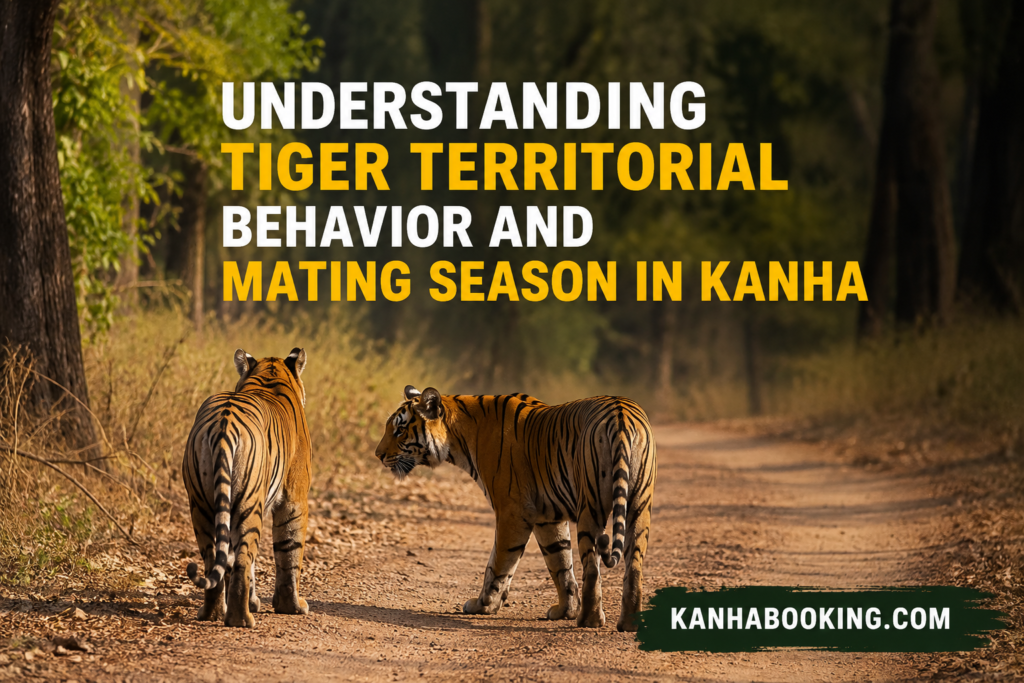
If you have ever sat quietly in an open gypsy inside Kanha National Park, waiting, watching the grass tremble and the jungle fall silent, you already know the feeling. Something big is close. That tension, that almost electric stillness, is what tiger territory feels like when you are inside it.
Kanha Tiger Reserve in Madhya Pradesh is one of those best places around the world where you can observe Bengal tigers behaving, pretty much just as nature wanted . The open meadows, dense sal forests, and the long stretches of grassland make the behavior noticeable, in a way that thick jungles really do not . Also, if you want to actually get what you’re seeing during a Kanha safari, it helps a lot to know how tigers mark their territory, and what happens when mating season arrives—because that little background shifts everything.
What Is Tiger Territorial Behavior?
Tigers are solitary by nature. They do not live in prides like lions or hunt in packs like wild dogs. Each tiger, male or female, lives within a defined area called a home range or territory, and they defend it seriously.
A male tiger’s territory in Kanha National Park is large. It often overlaps with the territories of two or three females, but rarely with other dominant males. Females hold smaller, tighter territories, usually chosen for their proximity to prey, water, and safe denning spots for raising cubs.
The way tigers communicate about territory is mostly invisible to us at first glance, like you would not catch it right away. It goes on through scent marking, scratch marks along trees, and a kind of haunting call that can travel far through the jungle. When a tiger rubs its face against a tree, sprays urine on a bush or drags its claws down a trunk, it’s basically leaving a message behind. That message says “this is mine”, I’ve been here recently, and I am doing quite well. Other tigers passing through notice those signals and then change their path accordingly, moving a bit different than before.
How Tigers Mark Their Territory in Kanha
If you pay attention during a Kanha jungle safari, you will notice spray marks at nose height on trees along forest paths. These are scent posts left by tigers. The chemical information in tiger spray carries details about the individual tiger’s identity, sex, age, and reproductive status.
Male tigers in Kanha, like those well known dominant males from Kisli and Mukki, move around their boundaries pretty regularly. They follow pretty much the same routes, renew old scent marks, and keep an eye out for signs from intruders, you know what I mean. When two big dominant males run into each other along a common border , the atmosphere can get tense fast. Territorial clashes among male tigers do take place in Kanha too, and naturalists who have spent years inside the park have actually seen some dramatic face offs around places like Singarpur meadow and Chotta Patther.
Females also mark territory, though less aggressively. A tigress becomes especially active in marking her area when she is in estrus, signaling to males that she is ready to mate. This is when the jungle comes alive with calls, scratch marks, and movement.
Tiger Mating Season in Kanha
Tiger mating in Kanha does not follow a strict calendar the way some animals do, but research by naturalists and scientists, including the landmark studies done at Kanha itself, suggests a clear peak. The most active mating period in Kanha runs from November through February. This coincides with the cooler months when tigers are naturally more active during daylight hours, making courtship behavior much more visible to safari visitors.
During mating season , a tigress will kinda move in her own special way. She vocalizes more than usual, leaves scent marks quite often, and sort of makes it obvious, she is available. A dominant male hanging around listens to all of that and follows her, almost like he’s tracking the whole story. The courtship stage in tigers can go on for several days before the real mating ever happens.
When the mating pair finally comes together, they stay close for about three to five days. While they are like that, they mate multiple times each day , not just once or twice. The male remains attentive but the female sets the timing and the tempo. Afterward, the male heads back to his own territory, and the female goes forward with the pregnancy by herself.
The gestation period in tigers is around 103 to 105 days. A tigress typically gives birth to two to four cubs in a quiet, hidden den, often inside dense forest cover or a rocky hollow. The cubs are born blind and completely dependent on the mother.
Dominant Males and Territory Fights
In Kanha, a handful of dominant males control large territories. Famous names among the naturalist community include tigers from the Kanha safari zone, Kisli zone, and Mukki zone who have sired multiple litters across their lifetimes, dramatically contributing to the park’s growing tiger population.
When a young male tiger matures and becomes strong enough to challenge an older dominant, the tension is real. These young tigers, sometimes called nomads, move through different zones looking for an opportunity. Sometimes a dominant male is ousted and his territory is taken over. This has been witnessed multiple times in Kanha’s history, including in areas around Babathenga and Neela Nala.
For a safari visitor, the best sign that territory is being contested is a fresh pugmark trail that cuts across an older one, deep scratch marks on a tree at chest height, or the sound of distant tiger calls early in the morning.
What This Means for Your Kanha Safari
Understanding this behavior completely changes how you experience a Kanha safari. When your naturalist points to a scratch mark on a tree and says this territory belongs to a certain male, you are reading the jungle like a book. When a tigress is spotted calling at dawn, you know she may be in estrus and a sighting of a mating pair could follow.
The Kisli and Mukki safari zones are especially productive for observing dominant male tiger behavior and mating activity during the cooler months. The Kanha zone with its wide open maidans gives you visibility across long distances, which makes reading tiger movement in real time much easier.
If you are planning a Kanha jungle safari specifically to observe tiger behavior during the mating season, book your visits between November and February for peak courtship activity, or March to May for excellent overall tiger visibility as vegetation thins out and water sources concentrate animals.
Female Tigers and Cub Rearing in Kanha
After mating, the story does not end. It continues in the most private corners of Kanha’s forest. A pregnant tigress withdraws from open areas and disappears into dense cover. When her cubs arrive, she raises them entirely alone, hunting, protecting, and teaching for the next 18 to 24 months.
In Kanha, tigresses with cubs are regularly spotted. Some of the most memorable safari moments guests experience are a mother tigress leading small cubs across a forest path, the cubs alert, curious, and stumbling slightly as they navigate the world outside their den for the first time.
Female tigers in Kanha sometimes practice what researchers call fake mating, allowing a dominant male to approach them even when they are not actually in estrus. This is a protective behavior. A tigress with small cubs will sometimes do this to prevent an aggressive male from killing her litter, since male tigers occasionally kill cubs that are not their own.
Tips for Spotting Tiger Behavior at Kanha
Go in the early morning. Tiger activity peaks in the first two hours after sunrise. Most territorial marking, courtship calling, and movement happens before 9 AM.
Listen before you look. A distant tiger call, alarm calls from deer or langurs, or sudden silence from birds are all clues that a tiger is moving nearby.
Focus on water sources in summer. Between March and June, tigers visit waterholes more frequently. These spots are excellent for long, relaxed sightings.
Ask your naturalist about fresh signs. A good naturalist reads the forest constantly. Fresh pugmarks, warm scat, or recently sprayed trees tell you a tiger passed through within the last few hours.
Book early, especially for winter months. Kanha safari slots for November to February fill up quickly. Booking through kanha jungle safari booking in advance secures your zone and timing before slots run out.
FAQs
Peak mating activity in Kanha occurs from November to February, though mating can happen throughout the year.
Through scent spraying on trees, scratch marks, and vocalizations along regular patrol paths.
A dominant male’s territory in Kanha can span 60 to 100 sq km, overlapping with several female territories.
Kisli, Mukki, and Kanha zones are all excellent. Mukki and Kanha zones have open meadows that make behavior easier to observe.
A mating pair in Kanha typically stays together for three to five days.
Cubs born from November-February matings typically appear with their mothers between March and June, roughly 3 to 4 months after birth.
No. After mating, the male returns to his territory. The tigress raises cubs entirely on her own.
Yes, completely. You remain inside your gypsy at all times with a trained naturalist guide. The park rules ensure a safe distance is always maintained.
Conclusion
Kanha National Park isn’t only the place where you spot tigers. It’s also where you kinda get to see how tigers really live, like day to day, in their own rhythm. Each scent mark on a tree, every territorial call around dawn, and then a tigress guiding her cubs across that misty meadow it all feels like a chapter, and that chapter has been going on here for ages, maybe centuries… not sure, but long enough.
When you understand tiger territorial behaviour and what their mating season looks like, a Kanha safari stops feeling like just sightseeing. You don’t stay stuck hunting for a quick flash of orange stripes. Instead you start reading the whole forest, piece by piece. And once that happens Kanha gives you way more than you thought you’d get, like honestly, more than expected.