Kanha National Park in Madhya Pradesh stands apart from most other parks in India. Decades of conservation work have shaped its forests. A deer species that nearly vanished was saved here. Rudyard Kipling also found the inspiration for one of his best loved stories in this landscape. So if you want to know what makes Kanha special, tigers are only a small part of the answer.
Below are the features that make Kanha different from every other wildlife destination in India.
The Only Home of the Hard Ground Barasingha
The biggest thing Kanha has going for it is the hard ground barasingha, a swamp deer you won’t find anywhere else on earth. People here call it the “Jewel of Kanha.” By the 1970s it was on the verge of extinction, with fewer than 70 individuals remaining.
Intensive protection, habitat management and grassland restoration changed that. Kanha’s forest department stuck with the effort, and the population today is over 600. This is the only place in the world where you can watch this 12 antlered deer in its natural wild habitat. Anyone serious about wildlife should put it on the list.
The Jungle Book Connection
Kanha is widely recognised as the main inspiration behind Rudyard Kipling’s The Jungle Book. Dense sal forests, open meadows, wolves, bears and tigers gave Kipling the material for Mowgli’s world. Few national parks in India can claim a direct link to literature like this.
Spend some time in the forests of Kanha and it’s easy to see why a storyteller like Kipling was captured by the place.
One of India’s Finest Tiger Habitats
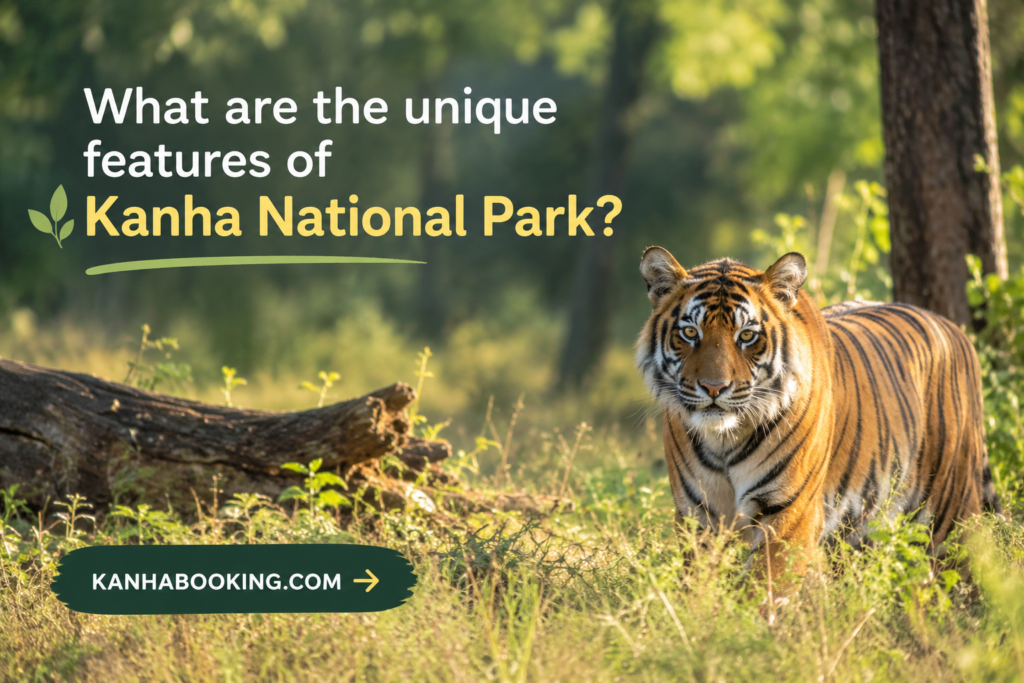
Kanha Tiger Reserve was one of the first reserves brought under India’s Project Tiger initiative in 1973. Recent surveys have recorded over 80 adult tigers and 40+ cubs, so the population here is among the healthiest and most stable in the country.
The open meadows are what make tiger sightings here so good. Picture a tiger crossing a Kanha maidan in early morning light, with a wide, clear view and nothing in the way. For tiger safaris, India has few better settings.
The Famous Maidans, Open Grassland Meadows
The open grassland meadows, called maidans locally, are one of the most distinctive parts of Kanha’s landscape. They were developed from former village lands as part of the park’s conservation management, and they now sit at the centre of the wildlife experience.
Barasingha, chital, gaur and sambar all depend on the maidans. Where prey gathers in the open, predators tend to follow. These meadows are consistently some of the most productive places for sightings in the park, particularly on early morning safaris.
Bamni Dadar, the Famous Sunset Point
Bamni Dadar is also known as the Sunset Point of Kanha. It’s a flat-topped plateau that rises to 870 metres, the highest point inside the park. At sunset, dense forest, rolling hills and the wide Kanha landscape turn golden in the evening light, and the view is hard to forget.
It’s also one of the best places in the park to spot gaur and deer, because animals gather on the open plateau in the late afternoon. Photographers and casual visitors both describe it as unmissable.
The Satpura-Maikal Landscape, a Unique Biogeographical Zone
Kanha Tiger Reserve lies in the Satpuda-Maikal landscape, a unique biogeographical unit of Central India that matters a great deal ecologically for the whole region. The park sits in the Maikal range of the Satpura hills, so the terrain varies a lot. There are flat-topped hills, low plateaus called dadars and wide grassland valleys. Three rivers, the Sulkum, Banjar and Nila, run through its core.
All this variety gives you several distinct habitat types inside one reserve. That’s why Kanha supports far more biodiversity than parks of similar size.
Exceptional Biodiversity Beyond Tigers
Kanha has over 43 species of mammals, 300+ species of birds, 26 species of reptiles and more than 1,000 species of flowering plants. It ranks among the most species-rich wildlife destinations in all of Asia.
Besides tigers, the key wildlife includes:
- Indian Leopard
- Sloth Bear
- Indian Wild Dog (Dhole)
- Gaur (Indian Bison), the largest wild bovine in the world
- Sambar, Chital, Barking Deer and Nilgai
- Paradise Flycatcher, Crested Serpent Eagle and 300+ bird species
Birdwatchers will like Kanha too. It’s one of the best spots in Central India, especially from November to February, when resident and migratory species fill the forest.
Four Distinct Safari Zones, Each With Its Own Character
The core of Kanha National Park is split into four safari zones: Kanha, Kisli, Mukki and Sarhi. Each has a genuinely different forest character and wildlife experience, which means no two safaris feel alike.
- Kanha Zone: open meadows, highest barasingha concentration
- Kisli Zone: dense forest, good tiger activity
- Mukki Zone: southern entrance, quieter and less crowded
- Sarhi Zone: offbeat and forested, ideal for wildlife photographers
There are also buffer zones at Khatia, Sijhora, Phen and Khapa. They suit visitors who want a quieter, more affordable forest experience on top of their core zone safaris. You can explore Kanha safari zone options and booking to plan the right combination for your visit.
A Gold Standard in Indian Wildlife Conservation
Kanha is widely seen as a gold standard for how a national park should be managed in India. It was among the first parks in the country to relocate villages out of the core area, which reduced human-wildlife conflict. Several other tiger reserves later copied the model.
The predator-prey balance is considered one of the healthiest of any tiger reserve in India. Tigers, leopards and wild dogs all have strong populations, backed by an abundant and well-managed prey base of deer, gaur and wild boar.
A Pioneer of Grassland Restoration in India
Few people know about Kanha’s pioneering work in grassland restoration, but it’s among its most significant features. Park management actively maintains and expands the open maidan areas that barasingha and other grassland species need. Other tiger reserves in India have studied this practice and replicated it.
Active habitat management is a major reason wildlife density and species diversity stay consistently high here, year after year. A Kanha National Park safari is rewarding whatever the season.
Best Time to Visit Kanha National Park
- October to February: cool weather, active wildlife, excellent birdwatching
- March to May: peak tiger sighting season, dry forest, animals near waterholes
- June to October: core zones closed during monsoon
FAQs: Unique Features of Kanha National Park
The hard ground barasingha, which exists nowhere else in the world. It came back from near extinction to 600+ individuals, and that makes Kanha irreplaceable in global wildlife conservation.
It earns the name through its extraordinary biodiversity, its iconic tiger population, the world’s only hard ground barasingha habitat, and its status as the inspiration for The Jungle Book.
Yes. Kanha is widely recognised as the primary landscape inspiration for Rudyard Kipling’s The Jungle Book. Its sal forests, open meadows, tigers, wolves and bears gave Kipling the setting for Mowgli’s world.
According to recent census data, Kanha Tiger Reserve has over 80 adult tigers and 40+ cubs. That makes it one of the highest tiger density reserves in India.
Bamni Dadar is the highest point in the park, at 870 metres, and is also known as Sunset Point. It offers panoramic views of the whole Kanha landscape, and visitors stop there for wildlife sightings and scenic photography.
Several things: the open maidan grasslands, the exclusive hard ground barasingha habitat, the Jungle Book connection, the variety across four core safari zones, and gold standard conservation management.
The hard ground barasingha, also called the swamp deer, which lives only here. Its numbers had dropped below 70 individuals, but conservation efforts have restored the population to over 600.
Conclusion
Kanha isn’t something you just visit. It stays with you. It has the only surviving population of hard ground barasingha on earth, and open maidans where tigers walk in the morning light. It has the Jungle Book forests that fired Kipling’s imagination, and the sunset views from Bamni Dadar. Each feature tells the story of a landscape that has been fiercely protected, carefully managed and allowed to thrive.
No single thing sets Kanha apart from every other national park in India. It’s the combination of wildlife diversity, conservation legacy, literary history, grassland landscape and the gold standard management that holds it all together. Very few places in the world offer this many layers in one destination.
Whether this is your first visit or your fifth, Kanha always has something new to show you. It could be a different zone, a different season, or a different morning light falling across the meadow in a way you’ve never quite seen before.