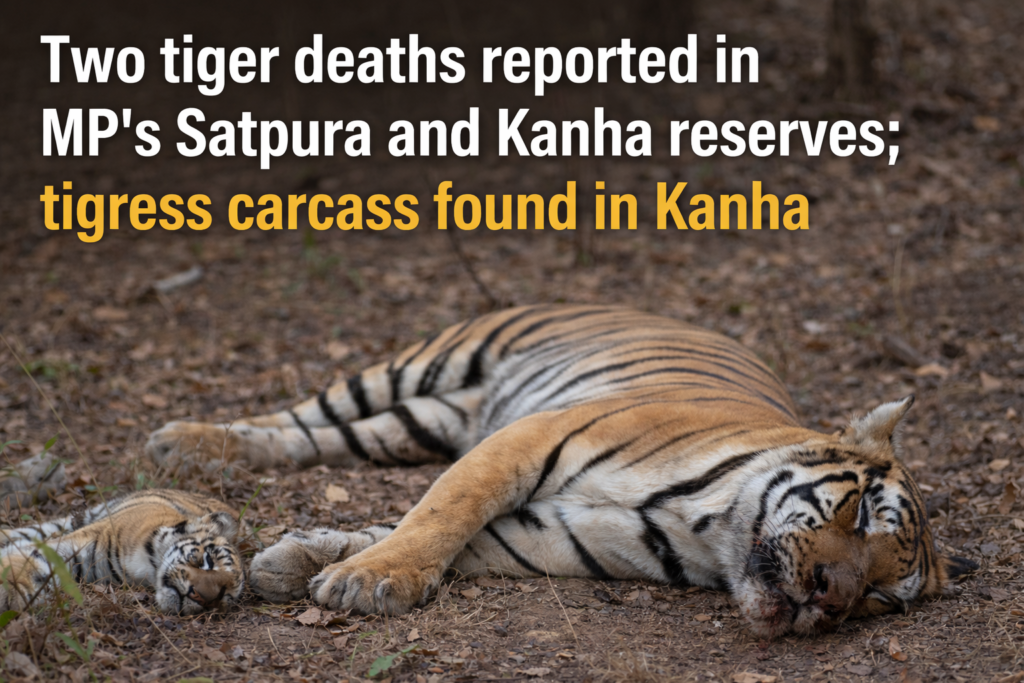
With 16 tiger deaths so far in 2026, Madhya Pradesh now accounts for more than 30% of the country’s total big cat fatalities this year
The forests of Madhya Pradesh fell silent over two of their own this weekend. A tiny four-month-old male tiger cub and a beloved ten-year-old tigress — roughly 150 kilometres apart — both lost their lives within a single half-day window, with forest officials pointing to one grim common thread: the raw, often brutal competition of the tiger mating season.
The deaths, which unfolded across Satpura and Kanha tiger reserves, have pushed Madhya Pradesh’s tiger fatality count for 2026 to 16 — a figure that now represents over 30% of all tiger deaths recorded across India this year, even as the country races to complete the sixth and final cycle of the All-India Tiger Estimation (AITE-2026).
Satpura: growls in the dark, a cub gone by morning
It began with a sound. On Saturday evening, patrolling staff deep inside the Matkuli Range of Satpura Tiger Reserve (STR) in Narmadapuram district heard loud growling echoing through the trees. When they tracked the source, they found the lifeless body of a four-month-old male tiger cub.
A post-mortem examination told a disturbing story — the cub’s body bore multiple claw and teeth injuries. Pugmarks discovered nearby pointed unmistakably to the presence of adult tigers, both male and female, moving through the same patch of forest during the height of the mating season.
“Investigations have raised the strong possibility of the male cub having been fatally attacked by an adult male tiger.” — Rakhi Nanda, Field Director, Satpura Tiger Reserve
Infanticide by rival adult males is a documented but heartbreaking behaviour in big cat populations, particularly during mating cycles when dominant males seek to eliminate cubs fathered by competitors.
Kanha: the reserve loses one of its most beloved tigers
Hours later and far to the east, Kanha Tiger Reserve (KTR) was delivering its own devastating news. On Sunday morning, forest patrolling teams discovered the body of tigress Sunaina — officially tagged T-122 — in the Kanhari forest area under the Kanha range. She was ten years old, and for many wildlife enthusiasts and tourists, she was the face of Kanha.
Senior forest officials immediately secured the site and launched a systematic search of the surrounding area with a dog squad. A veterinary team led by wildlife expert Dr Sandeep Agrawal conducted a thorough post-mortem examination. Crucially, all of Sunaina’s body parts were found intact — ruling out any possibility of poaching. However, deep wounds on her body told a different story.
“The nature of deep injuries also pointed towards the possibility of the tigress having been killed during a territorial fight with another adult tiger.” — Ravindra Mani Tripathi, Field Director, Kanha Tiger Reserve
Following established protocol under guidelines from the National Tiger Conservation Authority and the office of the Chief Wildlife Warden, Madhya Pradesh, Sunaina’s remains were cremated in the presence of forest officials, local administration representatives, wildlife experts, and independent observers. Every step was documented through photography and videography. A forest offence case has since been registered, and investigations continue to determine the precise cause of death.
A reserve under pressure and why it matters
Kanha is no ordinary reserve. It is estimated to shelter around 120 adult tigers and roughly 40 cubs, with the adjoining forest tracts of Balaghat district further extending its reach as one of India’s richest tiger corridors. The density of big cats — while a conservation success story — also means that territorial rivalries are an ever-present reality, especially during the November-to-April breeding window.
As that window nears its close, the two deaths serve as a stark reminder that even in protected landscapes, nature’s own conflicts can be unsparing. For conservationists watching Madhya Pradesh’s mounting toll of 16 tiger deaths in just the first months of 2026, the numbers demand both vigilance and reflection.