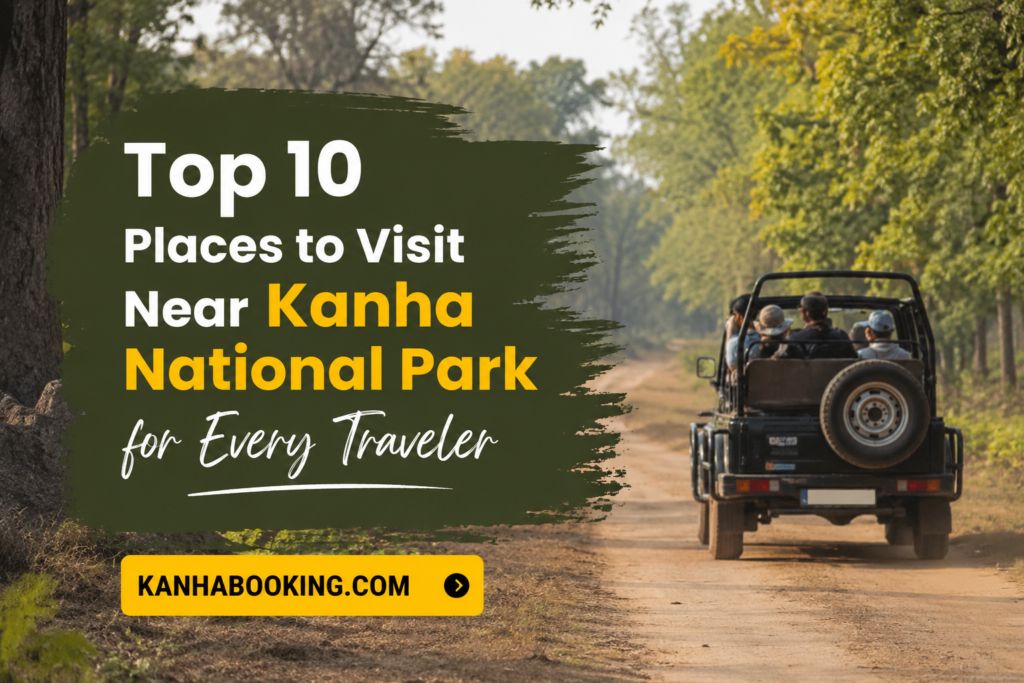
There is this sort of magic that kind of clings itself around Kanha National Park. Kanha’s lush forests are widely believed to have inspired the setting of Rudyard Kipling’s The Jungle Book. Its dense sal forests and huge grasslands still show that untamed setting that basically brought the story of Mowgli into being. Still, here’s the bit a lot of first-time visitors don’t really know or realize, the magic doesn’t just stop at the park boundary, it keeps going, and goes on…
The region surrounding Kanha National Park in Madhya Pradesh is packed with places that reward every kind of traveler: the history lover, the spiritual seeker, the waterfall chaser, the wildlife photographer, and the one who just wants to sit at a sunset point with a cup of tea and no plans. If you are heading to Kanha, block a few extra days. The places nearby are absolutely worth it.
Bamni Dadar — The Sunset Point of Kanha
Every visit to Kanha deserves to end at Bamni Dadar. Sitting at one of the highest plateaus in the region, this elevated viewpoint offers a sweeping view of the national park stretching out below — layers of dense forests, winding streams, and open meadows catching the last light of the day. At dusk, spotted deer and Indian bison (gaur) graze peacefully in the surrounding grassland while the sky turns orange and gold above the canopy.
Interestingly, Bamni Dadar also has a historical relic: an old airstrip the British once used to get an aerial view of the forest. For wildlife photographers, the golden hour light here is exceptional.
Kanha Museum — Where the Forest Tells Its Story
Located inside the park near Khatia Gate, the Kanha Museum is run by the Forest Department and is genuinely one of the most underrated stops on any Kanha trip. Inside, you will find skeletons of carnivores, reptiles, and herbivores, detailed charts of the food chain, wildlife specimens, and a photographic history of the reserve’s conservation journey.
The evening sound show is a highlight — a well-produced presentation on Kanha’s ecosystems that brings the forest to life in a way that a safari alone cannot. If you want to understand what you are seeing in the jungle, visit the museum first or after your first safari.
Banjar River Trail — Slow Travel at Its Best
The Banjar River is the quiet heart of Kanha sort of thing. It runs through the buffer zone, and its banks stay lush with riparian birdlife; kingfishers, herons and cormorants are usually there. You can enjoy a leisurely walk or a vehicle ride along the route, offering a completely different perspective from the core zone safari. It’s one of those places where you stop your talking, listen to the water, and then you realize how good it feels to be fully present, like right there in the moment.
Most lodges near Khatia Gate can arrange guided morning walks along the Banjar, a great activity to match up with your jeep safari days.
Mandla — History on the Banks of the Narmada
Around 40 km from Kanha, there’s Mandla, which is one of those places that kind of surprises you, if you really give it an honest hour or two, not just a quick look. The town sits on a bend of the Narmada River, and it keeps inside it the Mandla Fort, a 17th-century structure that rises sharply from the riverbank and gives sweeping, panoramic sights of what’s around you.
You’ll also find a number of old temples, plus this slow, unhurried vibe where everything feels more laid back and a bit more ordinary, in a good way. It’s a pretty solid half day add-on for anyone planning a Kanha trip. And along the Narmada, Rangrez Ghat and Rapta Ghat add even more of that quiet, lived-in charm.
Jabalpur — The Cultural Capital Near Kanha
At about 160 km from Kanha, Jabalpur is the closest major city, and honestly it kind of acts as the main gateway for most travelers when they arrive by air or train. But Jabalpur isn’t just a place to pass through. It’s known for the Bhedaghat marble rocks , those towering white cliffs made of crystalline marble through which the Narmada River keeps moving, like it has its own rhythm. A boat ride here, especially under the glow of a full moon, feels truly magical—like stepping into a completely different world for a while.
Dhuandhar Falls, where the Narmada plunges dramatically into a gorge creating a mist that looks like smoke, is another must-see. Add to this the Rani Durgawati Museum and the medieval Madan Mahal Fort, and Jabalpur easily earns a full day of your itinerary.
Raneh Falls — A Hidden Canyon Near Kanha
Man, not enough people really know about Raneh Falls, and honestly it feels kind of a shame. It’s located around 20 km from Khajuraho, and you can reach it when you’re on a Kanha–Khajuraho circuit, so it’s not even that hard to fit in. The falls themselves sit inside the Ken Gharial Sanctuary and they’re more like a set of waterfalls that slice through a really dramatic gorge, made of crystalline granite. The whole natural canyon in pink, red, and pale grey stone looks different, way different, compared to most places in central India.
The sanctuary around it is home to gharials, mugger crocodiles, and over 200 bird species. For nature lovers looking for something genuinely off the beaten path, Raneh Falls is the answer.
Amarkantak — The Sacred Origin of the Narmada
Around 157 km from Kanha National Park , Amarkantak is the place where the Narmada River starts to rise. It sits right where the Vindhya and Satpura hill ranges kinda meet, so the town feels enclosed by thick forests, little waterfalls, and a mix of age-old Hindu and Jain temple clusters. One spot people really talk about is the Dudh Dhara waterfall, it’s called that because the falling water seems like little streams of milk , flowing down in a quiet cascade. Overall it’s considered one of the calmest natural scenes around here.
Amarkantak is ideal for travelers who want to balance the energy of wildlife with something spiritual and slow. It pairs beautifully with the forest experience of Kanha.
Kawardha Palace — Royal Heritage Near the Forest
Somewhere around 92 km from Kanha , in Chhattisgarh, the Kawardha Palace sits quietly. It’s a heritage place, made with Italian marble, and it is surrounded by about 11 acres of neatly maintained gardens. Earlier , it was the residence of the royal family of Kawardha, but now it opens its gates to travelers as a heritage hotel, still , it stays available for day visits too. The Indo-Saracenic style, those long royal corridors, and the regal gardens make it feel like you are suddenly slipping into a different time again.
For travelers who love the intersection of wildlife and heritage, combining a Kanha safari with an evening at Kawardha Palace is one of the finest experiences this region offers.
Pench National Park — The Other Jungle Book Forest
Roughly 146 km out from Kanha , Pench National Park feels like the natural sidekick on pretty much any central India wildlife route. It’s also tied to Kipling’s Jungle Book, so the whole place has a kind of familiar echo to it. In Pench, you mostly go for tigers, leopards, wild dogs (dholes) and you also get over 300 bird species, all around. The Pench reservoir cuts right through the park too, and that little river-like presence gives a scenic mood that you dont often see in other reserves.
If you have an extra two to three days beyond your Kanha safari, a quick drive to Pench rounds out a central India wildlife experience beautifully.
Bandhavgarh National Park — India’s Tiger Capital
At around 210 km from Kanha National Park, Bandhavgarh is one of India’s most celebrated tiger reserve areas and it fits almost like a natural continuation to any Kanha plan. The place boasts one of the highest tiger densities in the country, so spotting chances often feel noticeably easier than in most other parks. And then you have more than just wildlife: Bandhavgarh Fort sits on top of an 800-foot rock, it carries ancient cave paintings plus man made caves, and it also carries a rather compelling story that stretches back more than 2,000 years.
The combination of Kanha and Bandhavgarh on a single trip is possibly the finest wildlife itinerary available anywhere in India.
Planning Your Kanha Trip
A well-planned Kanha trip typically needs five to seven days to do justice to both the national park itself and its surrounding destinations. The best time to visit is between October and June, with November to March being ideal for comfortable weather and great wildlife sightings.
For Kanha Safari Booking, all safari zones including Khatia, Mukki, Sarhi, and Kisli should be reserved in advance. Kanha Safari Booking services can help you plan your complete trip, including jeep safaris, accommodation, and customized wildlife tour packages covering Kanha and nearby destinations.
FAQs
Bamni Dadar, Kanha Museum, Mandla Fort, Jabalpur, Bhedaghat, Dhuandhar Falls, Pench, Bandhavgarh, Raneh Falls, and Amarkantak are popular nearby attractions.
Jabalpur is approximately 160 km from Kanha National Park.
Bamni Dadar is Kanha’s highest plateau and the region’s most famous sunset viewpoint.
Yes, Bandhavgarh is about 210 km from Kanha and is often combined with Kanha safari tours.
Yes, Pench is about 146 km from Kanha and is a popular combined safari destination.
Q6. What is Raneh Falls?
Conclusion
Kanha National Park is just the beginning of an extraordinary journey through the heart of Madhya Pradesh. From the golden silence of Bamni Dadar at sunset to the thundering drama of Dhuandhar Falls in Jabalpur, from the sacred stillness of Amarkantak to the royal grandeur of Kawardha Palace every destination near Kanha adds a completely different colour to your travel story.
Whether you are a first-time visitor chasing a tiger sighting or a seasoned traveler seeking something deeper in history, spirituality, nature, or culture this region genuinely has something for everyone.
Plan smart, book early, and give yourself more than just a weekend here. The forest and everything around it deserves your full attention.