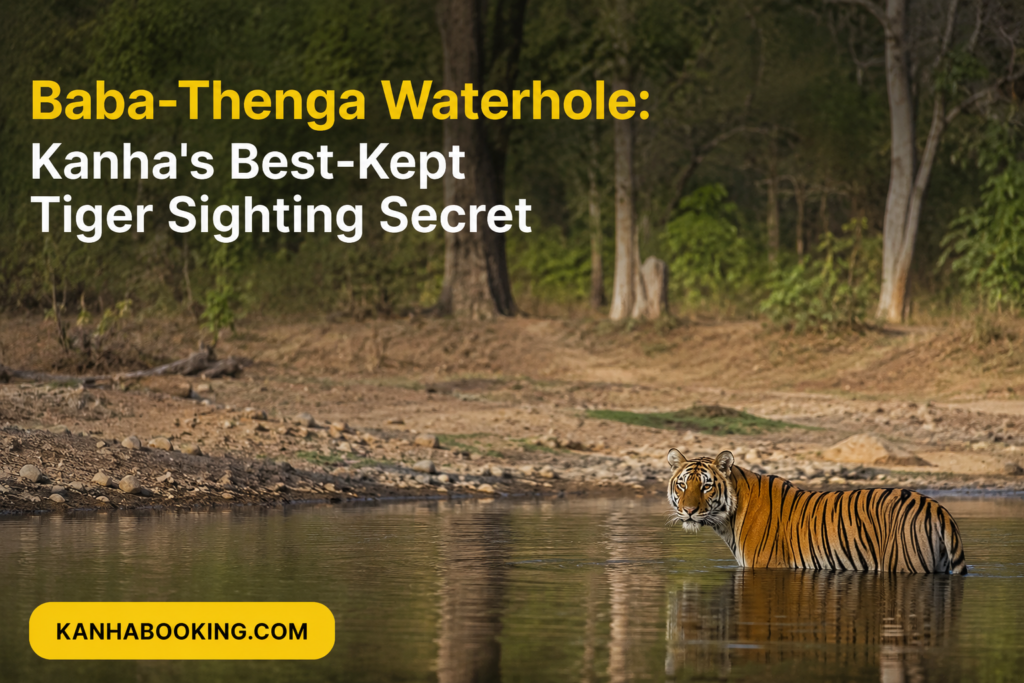
Every experienced wildlife traveller who has done multiple safaris in Kanha Tiger Reserve knows one name that rarely appears in tourist brochures but comes up in every serious tiger tracking conversation — Baba-Thenga Waterhole.
Tucked deep inside the Mukki Zone of Kanha National Park, Baba-Thenga is not your typical tourist attraction. There are no signboards pointing to it, no crowd of jeeps parked around it at dawn. It is the kind of place that experienced naturalists quietly factor into their safari route planning while first-timers are still asking about the famous meadows near Kanha gate.
If you are planning a Kanha safari and genuinely want to maximise your chances of a wild tiger sighting — read this carefully before you book.
What Is Baba-Thenga Waterhole?
Baba-Thenga Waterhole also written as Babathenga or BTW among regular Kanha visitors is a natural water body located along the Mukki safari circuit inside Kanha Tiger Reserve, Madhya Pradesh. It sits within the territory that connects the Dhawajhandi, Singarpur, and Malkhedi areas of the Mukki Zone.
The waterhole is permanent, meaning it holds water even during the peak of summer when most other water sources inside the park dry up completely. This single characteristic is what makes it so extraordinarily productive for tiger sightings especially between March and June when water becomes the rarest and most fought-over resource in the entire forest.
The area around Baba-Thenga is dominated by sal forest corridors and open transition patches — a combination that creates ideal conditions for predator movement. Tigers use the forest cover to approach the water unseen, and the open patches around the waterhole give safari visitors clear, unobstructed sightlines that can produce the kind of tiger photographs that wildlife photographers travel thousands of kilometres for.
Why Baba-Thenga Is Kanha’s Most Reliable Tiger Sighting Spot
Most waterholes in tiger reserves produce sightings by chance. Baba-Thenga produces sightings by design because of its geography, its permanent water supply, and its position inside an active tiger territory.
Here is what makes it genuinely different:
Permanent Water Source:
When Kanha’s seasonal streams and smaller pools dry out between April and June, Baba-Thenga remains. Tigers and other large predators have no choice but to visit — and they do so regularly and predictably. Experienced guides at Mukki plan their summer safari routes around Baba-Thenga’s waterhole activity for exactly this reason.
Active Tiger Territory:
Baba-Thenga sits at the heart of some of the most consistently active tiger territories in all of Mukki Zone. Over multiple seasons, significant tigers and tigresses have been regularly tracked in this area. The famous Dhawajhandi Female — one of Kanha’s most celebrated and photographed tigresses — has been sighted with her cubs near Babathenga across multiple seasons. In the 2022-23 season, she was spotted with five cubs near Babathenga, a record litter size for Kanha. Male tigers including Bheema have also been consistently tracked between Baba-Thenga Talao and the Dhawajhandi road during peak season.
The Alarm Call Network:
The forest around Baba-Thenga is alive with sambar deer, chital, barking deer, and langur — all of which give distinctive alarm calls when a predator is nearby. An experienced naturalist can read these alarm calls like a GPS signal for tiger movement. The open sal corridor between Singarpur and Baba-Thenga is one of the most reliable alarm call zones in the entire Mukki circuit, giving your guide crucial advance notice of tiger movement before the animal even enters the clearing.
Best Time to Visit Baba-Thenga Waterhole for Tiger Sightings
March to June — Peak Tiger Sighting Season:
This is without question the best time to plan your Baba-Thenga safari visit. As temperatures rise and water becomes scarce, tigers visit the waterhole with almost clockwork regularity — particularly in the early morning hours and late afternoon. April and May are the two most productive months, coinciding with the Nautapa period (the nine hottest days of the Indian summer calendar) when animals are most dependent on permanent water sources.
October to February — Active But Less Predictable:
Winter safaris through the Mukki Zone still produce Baba-Thenga tiger sightings, but the frequency is lower because water is available in more places across the forest. Wildlife is highly active and the forest is beautiful, but tiger visits to the waterhole are less concentrated than in summer.
July to Mid-October — Mukki Core Zone Closed:
The core Mukki zone, including the Baba-Thenga area, remains closed during monsoon. Some buffer zone access continues — but Baba-Thenga itself is not accessible during this period.
How to Reach Baba-Thenga Waterhole on a Kanha Safari
Baba-Thenga Waterhole is located inside the Mukki Core Zone of Kanha Tiger Reserve. It is accessible only through the Mukki Gate or Khatia Gate — you cannot reach it from Kisli or Kanha gate entries.
From Mukki Gate, reaching the Baba-Thenga area typically takes around 40 to 45 minutes by gypsy jeep, depending on the route your guide takes and wildlife stops along the way.
Key distances from major cities to Mukki Gate:
- Nagpur to Mukki Gate: approximately 250 km
- Jabalpur to Mukki Gate: approximately 178 km
- Raipur to Mukki Gate: approximately 182 km
To specifically target Baba-Thenga on your safari, book a Mukki Zone safari and inform your guide before entering the gate that you want to include the Baba-Thenga and Singarpur waterhole route in your circuit.
Wildlife You Can See Around Baba-Thenga
While tigers are the headline attraction, the Baba-Thenga area supports a rich variety of wildlife throughout the safari season.
Predators:
- Royal Bengal Tiger — primary attraction, frequent summer visitor
- Indian Leopard — seen in forested sections near the waterhole
- Indian Wild Dog (Dhole) — packs regularly sighted on the Mukki circuit
- Sloth Bear
Herbivores:
- Hard-Ground Barasingha — Kanha’s iconic species, often seen near open patches
- Chital (Spotted Deer) — large herds frequent the waterhole area
- Sambar Deer — key indicator species for tiger proximity
- Gaur (Indian Bison) — regularly seen near water in summer
- Barking Deer
Birds:
- Crested Serpent Eagle
- Indian Roller
- Red Junglefowl
- Malabar Pied Hornbill
- Various kingfisher and drongo species
Tips for Maximising Your Baba-Thenga Tiger Sighting Chances
- Book Mukki Zone morning safari — early morning is when tiger activity near waterholes is at its highest
- Go between April and May for the best summer waterhole sightings
- Tell your guide specifically that you want to include Baba-Thenga on the route — experienced Mukki guides already know its value
- Be patient at the waterhole — experienced visitors recommend waiting at least 20 to 30 minutes near Baba-Thenga rather than driving on immediately
- Listen for alarm calls — sambar and barking deer alarm calls near the waterhole almost always indicate a tiger is close
- Book multiple Mukki safaris — serious tiger enthusiasts recommend at least two to three Mukki safaris on any Kanha trip to give Baba-Thenga enough chances to deliver
Book Your Mukki Zone Safari for Baba-Thenga
Baba-Thenga Waterhole is accessible only through a Mukki Zone safari. Jungle Safari for Kanha National Park is booked through the kanha safari booking and fills up quickly during peak season from March to May.
If you are planning a Kanha safari specifically to visit Baba-Thenga and maximise your tiger sighting chances, we help you secure the right zone, and the right timing so your safari gives Baba-Thenga its best possible chance to deliver.
FAQs — Baba-Thenga Waterhole, Kanha National Park
It is located inside the Mukki Zone of Kanha Tiger Reserve, Madhya Pradesh.
Book a Mukki Zone safari through Mukki Gate or Khatia Gate.
March to June, especially April and May, offers the best chances.
Around 40–45 minutes by gypsy safari.
The Dhawajhandi Female, Bheema, and other Mukki resident tigers are frequently sighted.
No. It remains closed from July to mid-October.
Book 2–3 Mukki safaris for better tiger sighting chances.
Yes. You may spot barasingha, gaur, deer, leopards, sloth bears, dholes, and birds.
Conclusion
Baba-Thenga Waterhole is not just another spot on a Kanha safari map — it is the single most reliable tiger sighting location in the entire Mukki Zone, built on permanent water, active tiger territory, and decades of unforgettable encounters that serious wildlife travellers keep coming back for. If you are planning a Kanha National Park safari and a wild tiger sighting is your priority, Mukki Zone with a Baba-Thenga route is not optional — it is essential. Book your safari early, go in April or May for the best waterhole action, listen to your guide, and give the forest the time and silence it deserves. Baba-Thenga rarely disappoints those who come prepared and patient.