
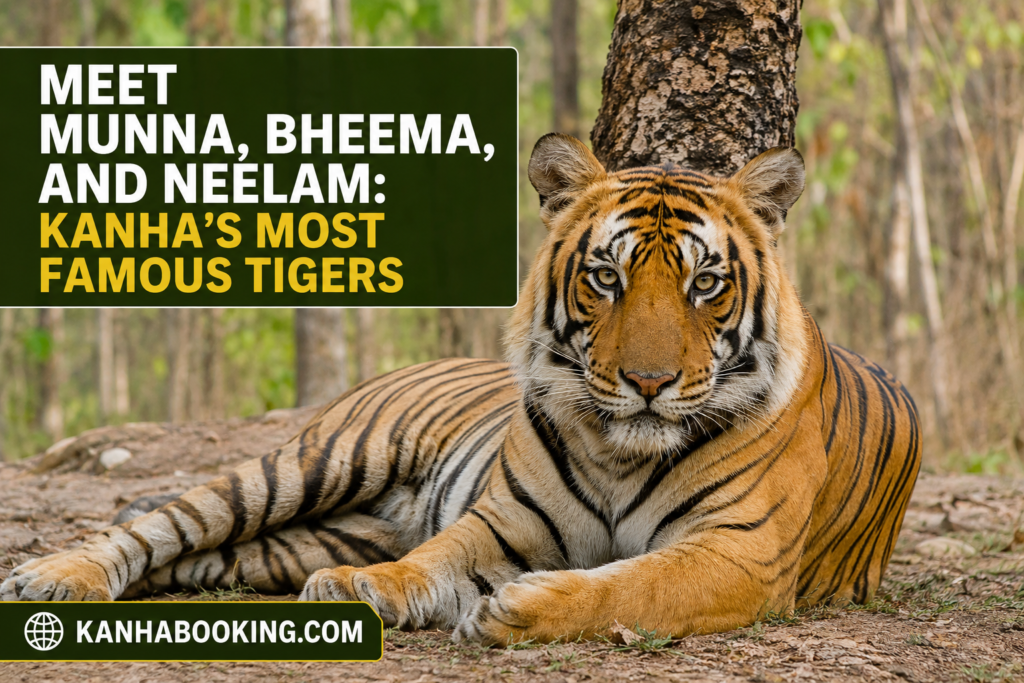
Kanha National Park, is one of India’s biggest wildlife destinations really, and honestly for good reason. It stretches across the center of Madhya Pradesh, and this grand tiger reserve is said to hold some of the most famous Bengal tigers ever recorded in India. Among them, three names have kind of turned into legends, for wildlife lovers, naturalists, and safari visitors too: Munna, Bheema and Neelam.
These are not just tigers. They are personalities. Each one has a story that spans years, territories, battles, family bonds, and extraordinary encounters with the wild. If you are planning a Kanha safari, understanding who these tigers are will transform your experience from a simple jungle drive into something truly unforgettable.
Munna (T-17): The King of Kanha
If Kanha has a rockstar, it is Munna. Known by the codename T-17, Munna earned his place as the most photographed and most recognised male tiger in Kanha’s history. His fame is literally written on his face: the black stripe markings on his forehead naturally form the letters C-A-T, a feature so striking and rare that it made him instantly identifiable to anyone who spotted him.
Munna spent the prime of his life patrolling the Kisli Zone of Kanha, moving through the sal forest with this calm confidence like a tiger who knew he ruled his land. He wasn’t just some dominant male or so, he was an apex warrior in the real sense of it. His boundary clashes with other tigers were brutal and often, and you could see the scars from those fights on him, like he wore them proudly. Even if he is known to sometimes spar and kill rival tigers, he still seemed pretty easy with safari jeeps and human visitors, almost serene about it. So basically, Munna ended up one of the most consistently spotted tigers in the reserve, again and again.
Over his long life, Munna became a father to some of Kanha’s next generation of famous tigers, including the tigress Neelam and Chhota Munna (T-29). His legacy did not end with him. It lives on through his descendants who continue to dominate zones across the park.
Park officials consistently described Munna as the face of Kanha, the reason photographers and wildlife lovers returned to the park year after year. To spot Munna was to witness living royalty.
Bheema: The Peaceful Warrior
Bheema holds a special place in the hearts of Kanha safari regulars. Born to his mother Budbudi and father Kankata, Bheema was one of four siblings and grew into a powerful, broad-shouldered male tiger who established himself primarily in the Mukki Zone.
What made Bheema beloved was his temperament. In the ruthless world of wild tiger territories, Bheema carried himself differently. He was nicknamed the Peaceful Warrior because even when he bore the wounds of territorial clashes, he carried those injuries without aggression or panic. Safari visitors and naturalists who regularly followed his movements noticed a quiet, composed energy about him that was rare among dominant male tigers.
For a period, Bheema and the Dhawajhandi female (T-27) became Kanha’s most-watched tiger pair in the Mukki Zone. Their pairing fascinated wildlife enthusiasts and naturalists who observed their dynamic across multiple seasons.
Bheema’s story came to a dramatic end following a territorial clash. His injuries from a fight eventually became too severe to recover from, and the Mukki Zone that he had so peacefully patrolled was taken over by Chhota Munna (T-29), the son of the legendary Munna.
Bheema’s life represents what makes Kanha’s wild tigers so compelling. They are not just animals, they are characters whose stories of strength, survival, and loss stay with you long after the safari ends.
Neelam (T-65): The Queen of Kanha
If Munna was the king, then Neelam is without question the queen. Codenamed T-65, Neelam was born in early 2012 to her legendary father Munna (T-17) and her mother Mundi Dadar (T-8). From the very beginning, she carried the genetics of royalty.
Neelam kind of established her area pretty firmly in the Kanha Zone, which is inside the park’s main tourism zones or close enough to that. That made her one of the most regularly seen tigresses in Kanha, but honestly it was her nature, her whole temperament, that really set her apart. People say she’s fearless and bold, and when the moment asks for it, she can be very aggressive too. She also shares part of her space with other tigresses, and yeah, boundary arguments, they happen often enough. Still, Neelam keeps her line, holds her ground with real authority, like without hesitation.
As a mother, Neelam has been… well extraordinary. Her first litter, three cubs, born in 2015, sadly did not make it, not all the way. The pressures of early cub life in the wild were just too much, and something inside that story felt harsh, and quick. But Neelam did not stop. She kept going. Her second litter—four cubs, sired by the dominant male Bajrang (T-64) — turned out into a tremendous success. She managed to raise all four to adulthood, which is not easy, it needs immense skill and a patient kind of stubborn courage, basically from any tigress who tries.
Neelam went on and had more litters, every time still proving she is a strong and capable mom, you know. She earned the title Queen of Kanha not because of one big dramatic moment , but more like years of dominance, staying alive, and quietly nurturing the next generation of tigers right there in this reserve.
With Munna as her father, Neelam carries one of the strongest tiger bloodlines in Kanha. Her story and legacy keep shaping the tiger population of the park for years to come as well.
Why These Three Tigers Matter for Your Kanha Safari
Munna, Bheema, and Neelam are more than wildlife celebrities. They represent the health, vitality, and conservation success of Kanha National Park. Their individual stories of territory, family, conflict, and survival are a window into the complex social lives that tigers live quietly in the forests we visit.
For safari visitors, knowing these tigers adds incredible depth to the experience. When your naturalist mentions a tigress moving through the Kanha Zone meadows, you will know you might be looking at Neelam or one of her descendants. When the pugmarks in the Kisli Zone dust are described as belonging to a large male, you will understand the legacy of Munna that still echoes through that territory.
Kanha is best explored through its zones: Kanha Zone and Kisli Zone for Munna’s old territory and Neelam’s current range, and Mukki Zone where Bheema once roamed and where Chhota Munna later took over. Booking a safari across more than one zone significantly increases your chances of a meaningful tiger encounter.
Plan Your Visit to See Kanha’s Famous Tigers
Kanha Tiger Reserve is open from October to June 30 every year. The best time for tiger sightings is from March to June when the summer heat brings tigers to water sources and open meadows, making them easier to spot. Morning safaris starting at 6:00 AM are widely considered the best slot for tiger activity.
Safari zones where these famous tigers and their descendants are most commonly sighted include the Kanha Zone, Kisli Zone, and Mukki Zone. Booking your safari in advance is strongly recommended since core zone permits sell out quickly during peak season.
You can book your Kanha safari online, which offers gypsy safari permits across all major zones with easy online booking, confirmed slots, and guidance on which zones to choose based on current tiger activity.
FAQs: Famous Tigers of Kanha National Park
Munna (T-17) is Kanha’s most famous tiger, known for the unique “CAT” marking on his forehead.
No. Munna has passed away, but his bloodline continues through tigers like Neelam (T-65) and Chhota Munna (T-29).
Neelam (T-65) is most often seen in the Kanha Zone.
Bheema died after injuries from a territorial fight, and his territory was later taken over by Chhota Munna (T-29).
The Kanha and Mukki zones offer the best chances of tiger sightings.
Book your safari online by selecting your preferred zone, date, and safari slot in advance.
March to June is best for tiger sightings, while October to February offers pleasant weather.
Kanha Tiger Reserve is home to more than 140 to 145 Bengal tigers.
Conclusion
Munna, Bheema and Neelam are the heart of Kanha’s tiger story, kind of, the whole thing…Each one lived, or keeps living, a life that feels dramatic, moving, powerful, like some wild tale you only see in nature. Munna was the legend that put Kanha right on the global wildlife map. Bheema was the warrior who made it clear that strength can sit alongside quiet dignity, not flashy just steady. And Neelam is the queen, carrying the bloodline forward with fearless grace, almost as if the forest itself is watching her.
Visiting Kanha without knowing their stories is like visiting a great museum without reading a single label. These tigers give the forest its meaning, and they give your safari its soul.