
If you have ever kinda asked yourself whether a trip to Kanha National Park is really worth it, the honest answer is yes, and not just yes but absolutely and without a doubt. Whether you are a first time traveller looking for something different or you’ve already visited a few other national parks, Kanha brings an experience that sticks with you long after you’ve come back home.
Right in the middle of Madhya Pradesh, the Kanha Tiger Reserve is one of India’s most respected and best managed wildlife places. It sprawls over almost 940 square kilometres of thick sal forests, open meadows, and bamboo groves, and honestly it feels like it’s more than tigers. This is more like you step into a living, breathing jungle, where nature just keeps on going, with its own rules, all by itself.
What Makes Kanha Different from Other National Parks
Many people wonder what sets Kanha National Park apart from other tiger reserves in India. The answer lies in a few simple things: the landscape, the variety of wildlife, and the sheer quality of the safari experience.
Kanha is the forest that kinda inspired Rudyard Kipling to write The Jungle Book. Mowgli, Sher Khan, Baloo—these characters sort of came alive out of the same forests you now drive through on a gypsy safari, right here. And that link to something so iconic, gives Kanha this magical sort of vibe which is hard to find anywhere else.
But beyond the legend , Kanha is also home to the hard ground Barasingha, a swamp deer species that is found in almost no other place on Earth. Once it was on the edge of extinction, the Barasingha numbers have come back to over 800 individuals, all within this park. Just that fact alone makes Kanha one of India’s top conservation triumphs.
Then there is the Royal Bengal Tiger. With over 100 tigers estimated within the reserve, your chances of a tiger sighting in Kanha are genuinely good, especially in the peak months of March to June when animals gather near waterholes.
What to Expect on a Kanha Jungle Safari
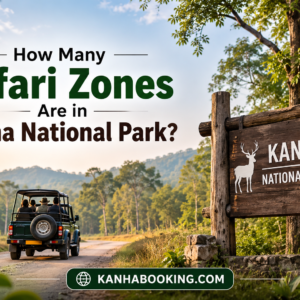
The main way to explore Kanha is through a jeep safari, also called a gypsy safari. An open-top vehicle takes you deep into the core zones with a trained naturalist guide who knows the forest, reads animal behaviour, and helps you understand what you are witnessing. Morning safaris start around 6 AM and run for four to five hours. Evening safaris begin around 3 PM and continue till sunset.
The experience is unlike anything you can watch on television. You hear the forest before you see anything. Alarm calls from deer, the chatter of langurs, the sudden silence before a predator appears. Your guide reads every cue and positions the vehicle for the best possible view.
Kanha has multiple safari zones to choose from. The Kanha and Mukki zones are the most popular for large predator sightings. Mukki, in particular, has earned a strong reputation for tiger sightings in recent years. Kisli and Sarhi zones offer excellent sightings too, with Sarhi being less crowded and great for birdwatching. The buffer zones like Khatia and Khapa are good for morning walks and relaxed exploration.
Wildlife You Can Spot in Kanha
One of the best things about Kanha is that a safari is never just about one animal. Even if you do not spot a tiger on a particular drive, the forest keeps giving.
Bengal tigers really are the biggest draw, and the park just seems to hold a healthy population. Leopards are around but kind of hard to pin down, so if you spot one its genuinely something worth celebrating, like honestly. Indian wild dogs, also known as dholes, are commonly seen in Kanha , often moving as a group and watching them hunt in the open meadows is one of the most exhilarating scenes you can witness in any Indian jungle. Sloth bears come out during those early morning drives, while gaur (Indian bison) graze near the forest clearings. And sambar along with chital deer are almost always there, no fuss, just visible.
Kanha is also exceptional for birdwatching, with over 300 species recorded. The Indian Paradise Flycatcher, Crested Serpent Eagle, Malabar Pied Hornbill, and Indian Roller are just a few highlights. If birds are your thing, the area near Khatia Gate during early morning walks is the place to be.
Best Time to Visit Kanha for Safari
The park is open from October 15 to June 30 every year. It remains closed during the monsoon months of July to September.
For comfortable weather and fairly active wildlife, October to March is ideal, I mean it just feels right. The mornings are cool, the jungle stays green and kind of fresh too, and most animals seem easier to spot in the open. If tiger sightings are your main thing, March to June is actually the best window. As temperatures climb, the thick vegetation starts to thin out, and the animals end up around the waterholes, so you get far more frequent ,and more predictable, chances to see them. Sure it gets hot, though dedicated wildlife travelers and photographers often choose this stretch for that exact reason.
Things to Do Beyond the Safari
Kanha is not only about the gypsy safari. The park and surrounding area offer a range of experiences for travellers who want to go deeper.
Guided nature walks around the buffer zone sort of lets you explore the forest on foot with a guide , and it’s ideal for birders and anyone who wants to slow down, pay attention to the tiny things in the jungle. Tribal village tours around Kanha bring you closer to the indigenous Gond and Baiga communities , who have lived alongside this forest for generations now. Their know-how about the land , plus traditional art and everyday ways of living gives the whole wildlife trip a totally different angle .
The Kanha Interpretation Centre near Khatia Gate has audio-visual exhibits on conservation, barasingha recovery, and the tribal heritage of the region. It is free to visit and great for families with children. Many resorts near Kanha also arrange bush breakfasts after morning safaris, campfire dinners under the stars, and sunset viewpoints in the buffer zone meadows.
How to Book Your Kanha Jungle Safari
Safari permits are limited and sell out quickly, especially during peak season from December to May. It is strongly recommended to book your Kanha safari in advance rather than relying on walk-in availability. You can secure your safari through an online Kanha safari booking, where you can choose your preferred zone, morning or evening timing, and vehicle type well before your travel date.
You will need to carry a valid ID proof (Aadhaar, driving licence, voter ID, or passport) at the safari gate. Make sure the name and details match what was used at the time of booking.
FAQs
Yes, absolutely. Kanha offers one of India’s finest wildlife safari experiences with excellent tiger sightings, diverse wildlife, and beautiful landscapes.
Two full days with four safaris (two morning, two evening) give you a solid experience. Three days are ideal if you want to explore multiple zones.
Mukki and Kanha core zones are currently the most popular for tiger sightings. Both offer great opportunities during peak season.
October to March is comfortable and great for wildlife. March to June is the best for tiger sightings, though it is hotter.
You can spot Bengal tigers, leopards, dholes, sloth bears, barasingha, gaur, sambar deer, chital, and over 300 bird species.
Yes. Kanha National Park closes from July 1 to October 14 for the monsoon season. Core zone safaris are not permitted during this period.
Kisli (Khatia) gate is popular for the Kanha and Kisli zones. Mukki gate gives access to the Mukki zone, which is currently the top choice for tiger sightings.
Conclusion
Kanha National Park is not only a place to go. It’s a place to experience, in a way that feels kinda unreal sometimes. From the rush of maybe spotting a tiger in the open meadows to the low key magic of seeing a herd of barasingha at dawn, every single moment in this forest seems to fit into a whole world that’s completely removed from normal, everyday life.
And if you’ve been thinking, whether Kanha is worth visiting for a wildlife safari, well the answer is basically there, in every alarm call that bounces through the sal trees. So plan your trip, book your safari early, and let Kanha show you what a real jungle feels like.