India is a land of incredible wildlife. From roaring tigers to majestic lions, the country has some of the finest national parks in the world. Two names that always come up in wildlife travel discussions are Gir National Park in Gujarat and Kanha National Park in Madhya Pradesh. Both are iconic. Both are stunning. But which one gives you a more unique wildlife experience?
If you are planning your next jungle safari and wondering where to go, this honest comparison will help you decide.
Overview: Two Different Worlds
Gir National Park is the only place in the world where you can see the Asiatic lion in the wild. Located in the Junagadh district of Gujarat, Gir covers over 1,412 square kilometres of dry deciduous forest, teak trees, and rugged terrain. It is not just a park, it is the last stronghold of a species that nearly disappeared from Earth.
Kanha National Park, on the other hand, is the crown jewel of tiger reserves in India. Situated in the Mandla and Balaghat districts of Madhya Pradesh, Kanha stretches across 940 square kilometres of core forest and nearly 1,949 square kilometres of total reserve area. It is famous for the Royal Bengal Tiger, the rare hard-ground Barasingha deer, and the lush Jungle Book forests that inspired Rudyard Kipling himself.
Both parks protect endangered species. Both offer gypsy safaris through pristine jungle. But the wildlife you see, the landscapes you explore, and the overall feeling are completely different.
Star Animal: Lion vs Tiger
This is the biggest difference between the two parks.
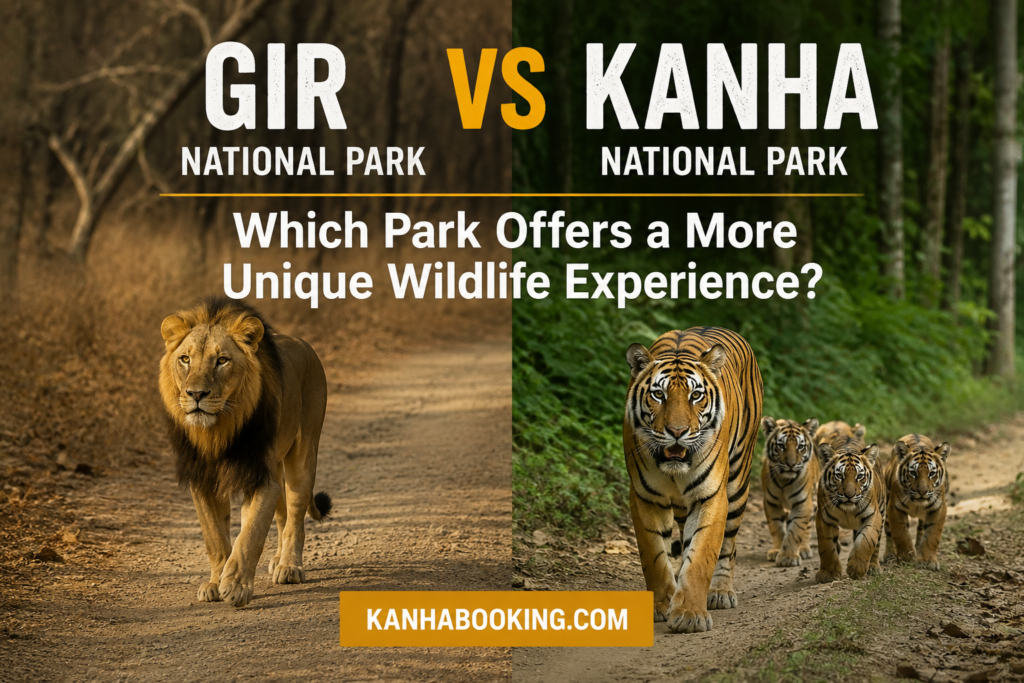
At Gir National Park, the star is the Asiatic lion. With over 890 lions now living in and around the park, Gir has one of the best lion sighting rates in the world. These lions are smaller than African lions and carry a unique fold of skin along their belly. Seeing a lion pride resting under a tree or a male walking across an open path is a rare experience you cannot find anywhere else on the planet.
At Kanha, the star is the Royal Bengal Tiger. Kanha houses over 145 adult tigers with dozens of cubs, making it one of the richest tiger populations in India. Tiger sightings are thrilling and the park is well known for successful Project Tiger conservation work since 1973. Apart from tigers, Kanha is also the only place where you can see the hard-ground Barasingha, a swamp deer that was brought back from the brink of extinction through dedicated conservation efforts right here in this park.
If seeing a lion in the wild is your dream, Gir is the only answer. If a tiger safari in India is on your bucket list, Kanha is one of the best places to make it happen.
Wildlife Diversity: Which Park Has More to Offer?
Both parks are rich in wildlife beyond their headline animals.
Gir National Park is home to leopards, sloth bears, striped hyenas, golden jackals, crocodiles at the Kamleshwar Dam, and the rare Indian pangolin. The park has over 300 bird species including painted sandgrouse, crested serpent eagle, Indian skimmer, and the endangered lesser florican. For birdwatching enthusiasts, Gir is outstanding. The unique mix of dry scrub, forest, and waterways supports biodiversity that feels very different from parks in central India.
Kanha National Park offers its own incredible diversity. Alongside tigers and barasingha, the park is home to leopards, Indian wild dogs called dholes, sloth bears, gaur or Indian bison, spotted deer, sambar deer, and wild boar. Kanha also has over 300 bird species. The open meadows or maidans of Kanha National Park make animal spotting easier because animals come into the open grassland. The landscapes of bamboo groves, sal forests, and clear streams make every safari visually beautiful.
For overall wildlife diversity and ease of sighting different animals in open terrain, Kanha has a slight edge. But for spotting large cats reliably and experiencing something globally unique, Gir stands apart.
Safari Experience: What to Expect
At Gir National Park, gypsy safaris are conducted twice daily, in the morning and late afternoon. The park has multiple safari zones including Sasan Gir, Devalia, Kankai, and Ambardi. Devalia is a fenced enclosure ideal for families wanting guaranteed lion sightings. The core Sasan Gir zone gives a more natural and raw experience. Safaris last around three hours and vehicle numbers inside the park are strictly limited to protect the wildlife.
At Kanha, gypsy safaris also run in the morning and evening slots, typically from 6 AM to 11 AM and 3 PM to 6 PM. The park is divided into eight zones: four core zones which are Kanha, Kisli, Mukki, and Sarhi, and three buffer zones which are Khatia, Khapa, and Sijora, plus the Phen Wildlife Sanctuary. The Kanha and Mukki zones are most popular for tiger sightings. Safari duration is four to five hours. The forest roads here wind through stunning sal forests and wide-open meadows that feel straight out of a storybook.
For Kanha safari booking, it is strongly recommended to book at least 30 days in advance for Indian visitors and 90 days ahead for international tourists, especially for peak season between March and June.
Best Time to Visit
For Gir National Park, the best time to visit is between December and April. The weather is pleasant, animals are active, and lion sightings are at their peak. The park closes from June 16 to October 15 every year due to the monsoon season.
For Kanha National Park, the park is open from October 15 to June 30. The best time for wildlife sighting is from March to June when vegetation thins and animals come out to water sources, making tiger spotting much easier. The October to February period is great for pleasant weather and lush green landscapes. Like Gir, the core zones close during the monsoon season from July to October, though some buffer zones remain accessible.
Landscape and Atmosphere
Gir has a dry and rugged character. The rocky terrain, teak forests, and thorny scrub give it a rawness that is different from the green parks of central India. Walking through Gir National Park feels like stepping into a landscape where lions have ruled for thousands of years. There is a sense of history and survival in the air.
Kanha feels like a fairy tale forest. The park that inspired The Jungle Book has wide green meadows, tall sal trees, gentle hills, and clear rivers. The atmosphere is magical and serene. Families with children often prefer Kanha because the landscapes are gentler and the wildlife encounters feel immersive without being intimidating.
Which Park Is Right for You?
Choose Gir National Park if you want to see the Asiatic lion, the only wild lion population in Asia, and enjoy a dry, rugged, and historically significant wildlife sanctuary with excellent birdwatching.
Choose Kanha National Park if you want to see the Royal Bengal Tiger, the rare Barasingha, and enjoy a lush Jungle Book landscape with one of the best-managed tiger reserves in India, supported by easy online Kanha safari booking options.
The truth is, both parks offer a wildlife experience that is genuinely unique. Gir is one of a kind because of the lion. Kanha is extraordinary because of the tiger and the conservation success story behind it. If you can, visit both. India is lucky to have both.
Frequently Asked Questions
Both are great for first-timers. Kanha is slightly more beginner-friendly because of better tourism infrastructure, easy online booking, and more open landscapes. Gir is ideal if seeing a lion is your specific goal.
No. Asiatic lions are found only at Gir. Bengal tigers are not found at Gir. Kanha is famous for tigers, not lions. Each park has its exclusive star animal.
Both parks have over 300 bird species. Gir has the edge for rare dry-forest species and waterbirds near the Kamleshwar Dam. Kanha is excellent for forest birds along the buffer zones.
Yes. Both parks are safe for families. All safaris are done in open gypsy with trained guides. Kanha is slightly more family-friendly because of gentler landscapes and longer safari routes.
Yes. Gir closes from June 16 to October 15. Kanha core zones close from July 1 to October 14. Some Kanha buffer zones remain open through the monsoon.
Kanha is accessible from Jabalpur, Nagpur, and Gondia by air and rail. Gir National Park is best reached via Rajkot or Junagadh. Both parks require some road travel after arriving at the nearest city.
Conclusion
Both Gir and Kanha National Park offer wildlife experiences that are truly one of a kind. Gir gives you something no other place on Earth can, a chance to see the Asiatic lion roaming freely in its natural habitat. Kanha gives you the thrill of spotting the Royal Bengal Tiger inside a forest that feels like a living Jungle Book. Your choice depends on what you want to see and what kind of experience you are looking for. If possible, plan a trip to both and discover two completely different sides of India’s incredible wild heritage.