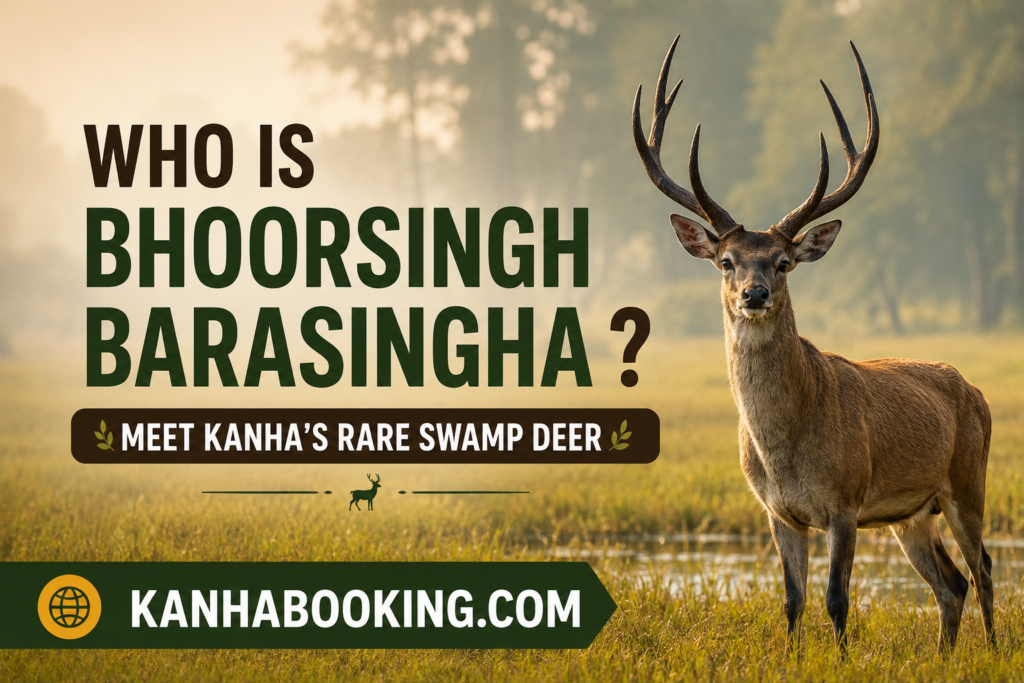
If you have ever visited Kanha National Park or even read about it, one name keeps coming up — Bhoorsingh. Not a tiger, not a leopard, but a deer. A very special deer that almost disappeared from the face of the earth, and then came back. That story alone is worth telling.
Bhoorsingh is the official mascot of Kanha Tiger Reserve, and behind that friendly cartoon face is one of the most powerful wildlife conservation stories India has ever witnessed.
Who is Bhoorsingh? The Name, The Animal, The Story
What Does Bhoorsingh Actually Mean?
The name Bhoorsingh comes from two Hindi words — “Bhoor” meaning tawny or golden-brown, and “Singh” meaning antlers or horns. Put them together and you get a beautiful description of the animal itself: the golden-antlered one.
This is the barasingha—scientifically known as Rucervus duvaucelii branderi , and more popularly called the hard ground swamp deer. The word barasingha by itself means “twelve-horned” in Hindi, and it’s really pointing to the impressive crown of antlers adult males carry. In truth the antlers can have about 12 to 20 tines, so they start to look almost like a small tree that’s growing straight from the deer’s head.
In 2017, Kanha became the first tiger reserve in India to officially introduce an animal mascot, and the barasingha was chosen — not the tiger, not the leopard, but this quiet, graceful deer. That choice was deliberate and meaningful.
Why Was Barasingha Chosen Over the Tiger?
It is a fair question. Kanha National Park is famous for its tigers, so why make a deer the face of the reserve?
The answer is simple: the barasingha is found nowhere else on earth in the wild except Kanha. The hard ground barasingha is unique to this forest. It evolved specifically to walk on firm ground rather than marshy wetlands like other barasingha subspecies. That exclusivity made it the true symbol of what Kanha protects.
The tiger represents India. The barasingha represents Kanha.
The Hard Ground Barasingha — What Makes It Different
Not Your Ordinary Swamp Deer
There are three subspecies of barasingha found across India and Nepal. The one in Kanha — the hard ground barasingha is distinct from the rest in several important ways.
Unlike the wetland barasingha you might spot in places like Kaziranga or Dudhwa, the Kanha subspecies sort of has hooves that are suited to dry, firm ground, you know. It keeps to open grassland, meadow type areas with sal forest around, rather than wandering into swampy tracks. Also, it’s a bit smaller than the wetland barasingha, but the antlers it carries are longer, more branched, and the coat looks darker and more lustrous.
When breeding season arrives, the coat shifts into this warm reddish-golden brown tone, which is almost like it glows in the early morning sun. Especially when herds gather in Kanha’s well known maidans, those open meadows where everyone ends up. Watching fifty or even a hundred of them grazing together is one of those wildlife scenes that just doesn’t leave your mind quickly.
Where Exactly in Kanha Can You Spot Barasingha?
The best sightings happen in the large open meadows — the Kanha Maidan and Sondar Maidan are particularly known for barasingha herds. If you are booking a safari in the Kanha Zone or Mukki Zone, your chances of spotting them are very good, especially during early morning safaris when the deer move out to graze.
They tend to stay in groups, so once you see one, you often see many. The sight of a large herd with adult males carrying full antler racks is genuinely breathtaking.
The Conservation Miracle — From 66 to Over 1,100
How Close Did They Come to Disappearing?
This part of the story is hard to believe, but it is completely true.
In 1953, around 551 barasingha were recorded in Kanha. By 1967, that number had collapsed to just 66 individuals. Sixty-six animals. The entire world population of the hard ground barasingha had been reduced to a single small herd inside one national park, pushed there by decades of hunting, habitat loss, livestock competition, and disease.
For context, that is fewer animals than you might see in a small zoo. The species was genuinely on the edge of forever disappearing.
What Did Kanha Do to Save Them?
The recovery did not happen by accident. It was the result of careful, sustained, and sometimes creative conservation work that started in the late 1960s — even before Project Tiger was launched.
Forest managers at Kanha took several steps that together turned the tide. Roughly 35 forest villages were relocated to expand the core protected area and give the deer more space. Former village lands were converted into productive grasslands by actively managing the vegetation — removing woody plants and weeds and encouraging the grasses that barasingha prefer to eat.
Predator-free enclosures called boma were set up inside the park, giving small groups of barasingha a safe space to breed without the stress of tiger predation. The first such enclosure was around 25 hectares. As numbers inside grew, it expanded. Animals that grew strong and healthy inside were gradually released back into the open forest.
The results speak for themselves. By the 1980s the population crossed 200. By 2015 it had reached 450. By 2020 the count stood at around 800, and current estimates suggest the number is now above 1,100 animals — all living in the wild inside Kanha.
That journey from 66 to 1,100 is genuinely one of the finest conservation recoveries in Asia.
Bhoorsingh the Mascot — More Than Just a Logo
How the Mascot Was Created
The idea for Bhoorsingh came during a meeting between Kanha’s field director Sanjay Shukla and cartoonist Rohan Chakravarty, who had visited the park in early 2017 for another project. They wanted to give Kanha a distinct identity that would connect with younger visitors and spread awareness about the barasingha’s story.
Four design variations were created. The Madhya Pradesh Forest Department chose one, and Bhoorsingh was born. The cartoonist himself said the decision to pick the barasingha over the tiger was a conscious one because the barasingha is what makes Kanha truly unique.
Since then, Bhoorsingh has appeared on park signage, merchandise, educational materials, and awareness campaigns. He is not just a mascot — he is a reminder of what Kanha fought hard to protect.
Planning Your Kanha Safari to See the Barasingha
Best Time and Zones for Barasingha Sightings
The barasingha can be spotted throughout the park season, which runs from October to June 30. The best sightings tend to happen between November and March when the meadows are clear and the deer are most visible. During the mating season in December and January, adult males with full antlers are particularly impressive.
For zones, the Kanha Zone (accessible from Khatia/Kisli gate) and the Mukki Zone offer the highest chance of barasingha encounters because they include the main meadow areas where herds gather. Morning safaris are strongly recommended — the deer are active and the light is beautiful for watching and photography.
How to Book Your Safari
If you are planning a trip to Kanha specifically to see the barasingha (and honestly, why wouldn’t you?), booking your safari slot in advance is essential. Safari permits are limited and fill up quickly, especially during peak months.
You can check Kanha Safari Booking availability, dates, and gypsy safari options for major zones such as Kanha, Mukki, Kisli, Sarhi, and buffer zones. Booking in advance also increases your chances of getting preferred morning safari slots, which are popular for wildlife sightings.
FAQs About Bhoorsingh Barasingha and Kanha Safari
Bhoorsingh is the official mascot of Kanha National Park — a cartoon representation of the hard ground barasingha, introduced in 2017.
It means “twelve-horned” in Hindi, referring to the twelve or more tines on the deer’s antlers.
Yes. The hard ground barasingha exists only in Kanha in the wild. A small group has been translocated to Satpura Tiger Reserve, but Kanha remains the primary stronghold.
Current estimates put the wild population at over 1,100 individuals — a remarkable recovery from just 66 in 1967.
The Kanha Zone and Mukki Zone, especially around the large open meadows, offer the best chances of spotting barasingha herds.
Yes. The hard ground barasingha is the state animal of Madhya Pradesh.
October to March is ideal. December and January are especially good during the mating season when males display full antler racks.
Conclusion
Bhoorsingh the Barasingha is not just a mascot or a logo on a sign at the park entrance. He represents something far more important — proof that when humans decide to protect a species seriously, it can come back.
From 66 animals teetering on the edge of extinction to a thriving population of over a thousand, the hard ground barasingha’s story is one of the most hopeful things to come out of Indian wildlife conservation. It happened because forest managers acted early, stayed consistent, and refused to give up.
When you visit Kanha and spot a herd of barasingha grazing in the golden morning light of the Kanha Maidan, you are not just watching deer. You are watching a species that almost vanished, and didn’t. That is worth every safari booking, every early morning, every moment of patience in the jungle.