
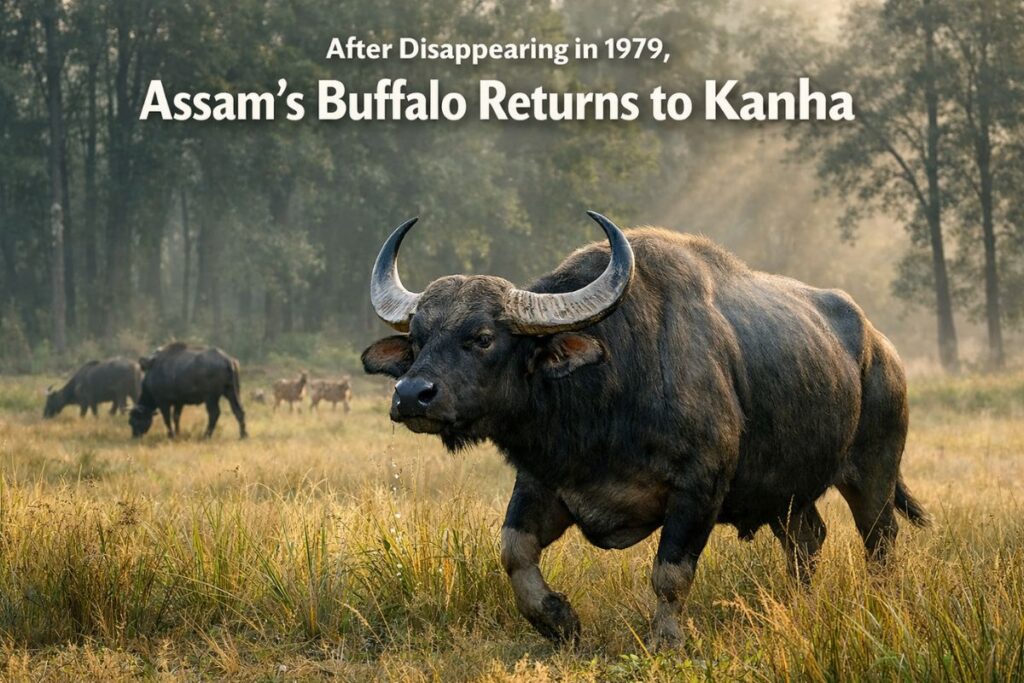
After almost five decades, wild buffaloes are finally coming back to Kanha Tiger Reserve in Madhya Pradesh. These buffaloes disappeared from the region many years ago, with the last confirmed sighting recorded in 1979, leaving nature lovers and wildlife experts hoping for their return.
Forest officials say between 12 and 15 endangered wild buffaloes will be brought to Kanha by early March 2026. These animals will come from Kaziranga National Park in Assam, which is home to one of the country’s healthiest and most genetically pure populations of wild buffalo.
Transporting these buffaloes is a big task. They will travel nearly 2,000 kilometres by road in specially built crates. Veterinary experts will travel with them to make sure they stay healthy and safe during the long journey. This careful planning is part of the wild buffalo reintroduction project in Kanha Tiger Reserve, aimed at restoring the species in its old home.
The buffaloes will be brought to a special area inside the reserve called a soft‑release enclosure. Here, they will get used to the new surroundings. After a few days of adjustment, they will be gradually released into the wild. Officials chose the March timeframe because the weather will be cooler and safer for the animals during travel.
Historical records and even ancient rock paintings from Bhimbetka show that wild buffaloes once lived in parts of central India, including the forests around Mandla, Balaghat, Amarkantak, and the Satpura range. But due to hunting, habitat loss, and other pressures over time, these buffaloes disappeared from Madhya Pradesh.
The Wild Buffalo Conservation Action Plan (2024) prepared by the Wildlife Institute of India identified Kanha as a suitable site for reintroduction. This is because Kanha National Park has healthy grasslands, wetland areas, and good protection systems in place. Experts believe the forest can one day support up to 200 wild buffaloes once the population becomes established.
This conservation effort is a coordinated project involving the Wildlife Institute of India, the forest departments of Assam and Madhya Pradesh, as well as national authorities. Officials hope that this first wave of buffaloes will help re‑establish a stable and genetically healthy population in central India.