
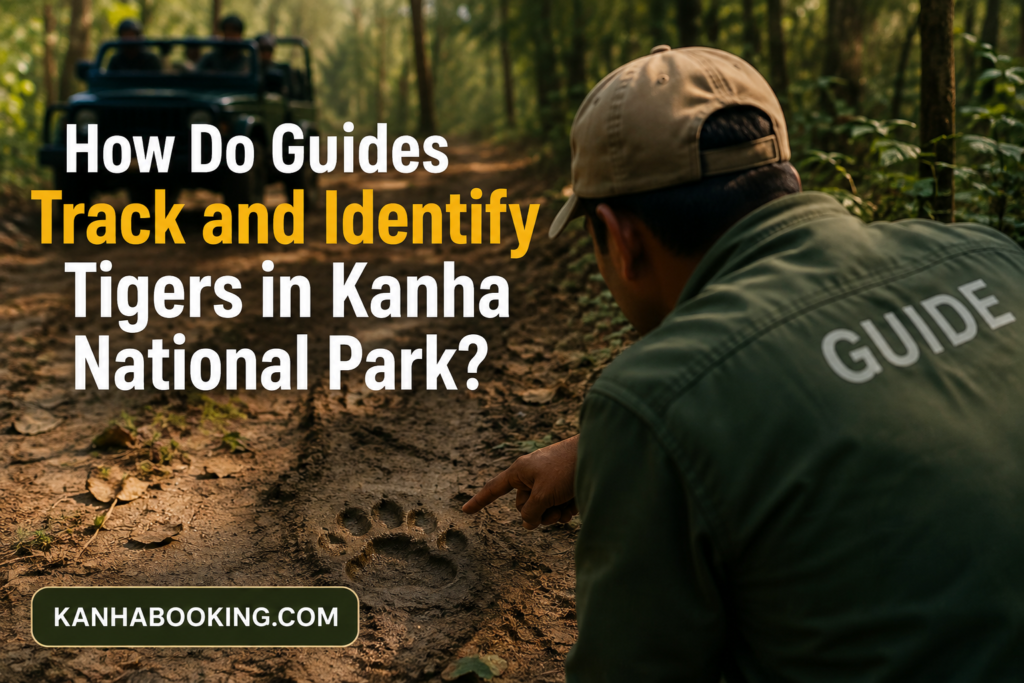
You step into an open gypsy before sunrise. The air smells of damp sal leaves and cool soil. Your guide stands quietly at the front, eyes scanning the muddy trail ahead. You have no idea where the tiger is. But somehow, your guide does.
That is the magic of a Kanha jungle safari.
Kanha National Park sits in Madhya Pradesh, and it is widely seen as one of India’s top tiger places. The park has more than 100 Bengal tigers in its forest belt. So yes, if you visit, you may spot one. Still, a tiger will not just appear in front of you. You need patience and know how to search. The guides and naturalists in Kanha have spent years learning that process, and they help you use it in the field.
So how exactly do they do it? Let us walk you through it.
Reading Pugmarks on the Trail
The first thing any Kanha National Park safari guide does is look down at the road.
Tiger pugmarks, the large paw prints left on muddy or sandy paths, are one of the most reliable signs that a tiger has passed through recently. A fresh pugmark means the edges are still sharp and the soil has not dried yet. That tells your guide the tiger could be just minutes ahead.
Experienced guides can read a lot from pugmarks alone. The size of the print tells them whether it is a male or female. The depth and spacing of the prints suggests the tiger’s speed and direction. Some guides who have spent years in the same forest can even identify specific tigers from their pugmark pattern alone.
This is why your guide always starts the safari slowly, watching the road carefully before speeding off anywhere.
Listening to Alarm Calls of the Forest
This is perhaps the most exciting and instinctive skill a Kanha National Park guide uses.
The forest talks. When a tiger moves through the jungle, every animal nearby knows it long before you do. Deer, langur monkeys, peacocks, and other creatures have evolved a sharp alarm system to warn each other about approaching predators.
A sambar deer will let out a loud, echoing call when it senses danger nearby. Langur monkeys sitting high in the tree canopy will give a sharp, urgent grunt. Spotted deer, called chital, will bark in short bursts. Each alarm sounds different, and each one means something specific to a trained guide.
When your guide suddenly stops the gypsy and tilts their head to one side, they are not daydreaming. They are reading the forest’s alarm system in real time. A sequence of calls from the same direction is a near-certain sign that something big is moving through that patch of jungle.
Following alarm calls is often the most reliable path to a tiger sighting in Kanha.
Knowing Tiger Territories and Behavior Patterns
Tigers are not random wanderers. They are highly territorial animals that move through the same areas repeatedly, following scent trails, hunting routes, and water sources within their home range.
Kanha’s guides and naturalists can name the tigers in the forest. They talk about which tiger moves through each patch of woods. They also note which female is caring for cubs this season. They even mention which male has moved into a new area.
They do not guess. They built this map over many years of day after day watching. They swap notes when they meet at the gate. They also take tips from rangers with the forest department.
Before every safari begins, guides and drivers exchange notes. Where was the tiger last seen? Which zone had activity this morning? These real-time conversations allow guides to shortlist the most likely areas before even entering the forest. It is fieldwork that happens before the safari starts.
Thinking Like a Tiger
This is something the best guides at Kanha do effortlessly and it is what separates a good safari from a great one.
After a guide spots the rough area where a tiger could be, they shift to the moment at hand. Summer can be fierce, so they look for shade and water. Early winter mornings are different. The tiger may be stretched on a warm strip of ground near the path, taking in the sun. If there was a hunt late the day before, they may just stay close to the carcass and rest.
This predictive thinking, combining knowledge of tiger behavior with real-time weather and habitat conditions, is how guides position the gypsy in exactly the right place at the right time. They are not chasing the tiger. They are waiting for the tiger to arrive.
Sharing Information Between Guides During the Safari
During a Kanha jungle safari, you will often notice your guide exchanging quick words with other guides whose jeeps cross paths. This is not small talk.
Guides in the field constantly share live information. A sighting in zone A twenty minutes ago tells your guide where the tiger was heading and at what speed. Cross-referencing multiple data points, pugmarks, alarm calls, past sightings, and territorial knowledge, the guide builds a real-time picture of where the tiger is most likely to be right now.
This network of live, on-ground communication between trained naturalists is one of the biggest reasons why tiger sighting success rates at Kanha National Park are among the highest in India.
Identifying Individual Tigers
Once a tiger is spotted, a trained guide or naturalist can often tell you exactly which tiger you are looking at.
Each Bengal tiger shows its own stripe layout. It is not the same as any other tiger’s pattern. Guides often tell them apart on safaris. They look at the face first, then the body size. They also note the ears. They pay attention to the stripes near the cheeks and on the forehead too. Those guides put in months and even years doing this work.
Kanha’s well-known tigers like the famous residents of the Mukki zone and Kanha zones are recognized on sight by experienced naturalists. This individual identification also helps track tiger health, breeding activity, territory changes, and cub survival over time.
The Role of Technology and Camera Traps
Alongside traditional field skills, modern tools also play a supporting role in tiger tracking at Kanha National Park.
Camera traps placed by the forest department across the reserve automatically photograph animals that walk past. These images are analyzed to record tiger presence, territory, and population data. While guides do not carry GPS trackers into the safari, the information collected through camera traps and annual tiger censuses gives the park authorities a detailed picture of which tigers are active in which zones.
The 2024 tiger census confirmed over 145 tigers including cubs in Kanha Tiger Reserve, making it one of the most tiger-dense parks in India. This healthy population directly improves your chances of a sighting when you book a safari.
FAQs: Tiger Tracking in Kanha National Park
Guides use a combination of fresh pugmarks, animal alarm calls from deer and monkeys, knowledge of tiger territories, and live information shared between safari vehicles.
A pugmark is a tiger’s paw print on a muddy or sandy trail. Fresh pugmarks with sharp edges indicate a tiger has passed recently and help guides identify direction, gender, and in some cases, individual tigers.
Sambar deer, chital (spotted deer), langur monkeys, and peacocks all give distinct alarm calls when they detect a predator. Guides read these calls to locate tigers.
Yes. Each tiger has a unique stripe pattern. Experienced naturalists at Kanha can recognize individual tigers by facial and body markings.
Mukki and Kanha zones are most popular for tiger sightings. Kisli and Sarhi are also good options with less crowd.
No sighting is ever guaranteed in the wild. However, Kanha National Park has one of the highest tiger sighting success rates in India, thanks to its healthy tiger population and skilled guides.
Conclusion
Tracking a tiger in Kanha is not luck. It is science, experience, and a deep love for the forest.
You follow pugmarks the way some people read a trail map. You hear the woods and it feels like a real back-and-forth. You can also guess what the tiger might do next, even before it moves. After many days on safari, and after watching specific tigers over time in their own areas, a Kanha naturalist becomes one of the best wildlife trackers anywhere.
Every safari at Kanha National Park is different. Some mornings the tiger walks right across the road. Other times you spend two hours in silence before a flash of orange strips through the sal trees. Either way, what you learn from your guide about how this forest works, how animals communicate, and how one apex predator shapes an entire ecosystem, stays with you long after you leave.