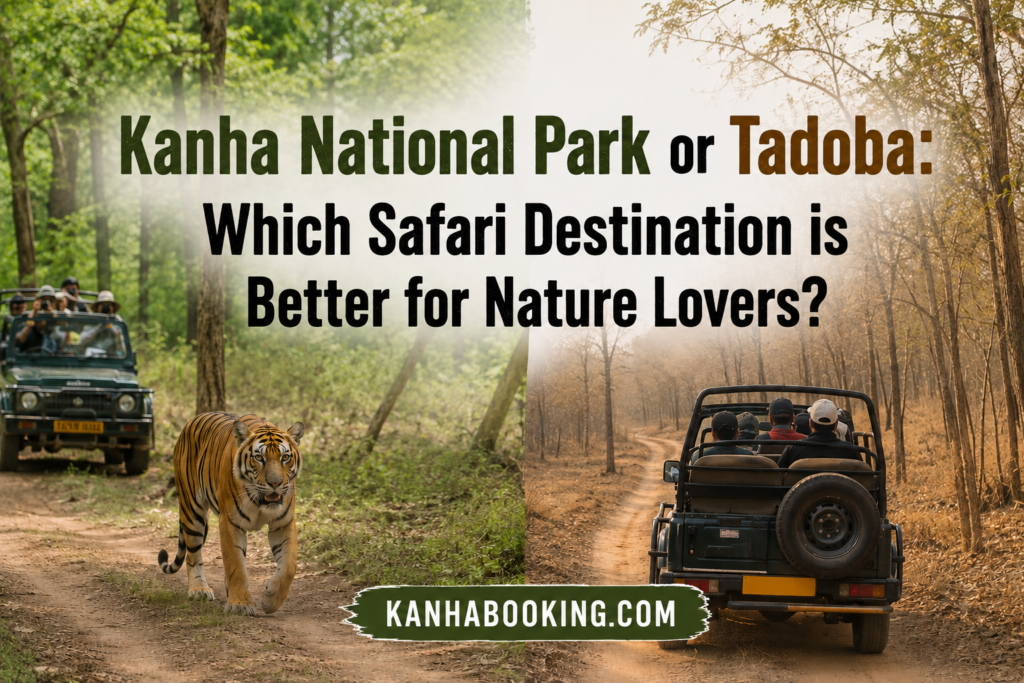
Two of India’s finest tiger reserves. Two completely different jungle personalities. Kanha National Park in Madhya Pradesh and Tadoba-Andhari Tiger Reserve in Maharashtra are both world-class safari destinations but they offer very different experiences on the ground.
Nature lovers visiting either park for the first time often walk away wondering why nobody told them the difference earlier. This comparison breaks it all down honestly, so you can choose what truly fits your expectations.
Kanha National Park: The Soul of Central India’s Jungles
Kanha National Park sits in the Mandla and Balaghat districts of Madhya Pradesh and covers a total reserve area of 1,949 square kilometres, making it the largest national park in Central India. The core zone alone spans 940 square kilometres, giving wildlife genuine space to move, breed, and behave naturally.
The forest is a mosaic of rolling sal and bamboo groves, open grassland meadows called maidans, winding streams, and gentle hillsides. It is this diversity of landscape that makes Kanha so visually rich and so rewarding for anyone who cares about the forest as much as the animals inside it.
Kanha is famously the forest that inspired Rudyard Kipling to write The Jungle Book. Mowgli, Sher Khan, Baloo, and Bagheera were all born from the wildlife and tribal culture of this very region. That connection adds a layer of storytelling to every safari that very few reserves in the world can claim.
The park is home to Bengal tigers, Indian leopards, wild dogs (dholes), sloth bears, gaur, golden jackals, and over 300 species of birds. Its most celebrated resident is the hard-ground barasingha, a swamp deer species pulled back from near-extinction entirely within Kanha National Park. Watching a herd of barasingha graze at dawn in an open meadow is one of the most peaceful and moving wildlife sights in India.
Kanha operates four main safari zones: Kanha, Kisli, Mukki, and Sarhi. Each zone covers a different portion of the forest and gives access to different wildlife territories. The park is open from October 15 to June 30 each year.
Tadoba-Andhari Tiger Reserve: Maharashtra’s Tiger Capital
Tadoba-Andhari Tiger Reserve in Chandrapur district, Maharashtra, is the oldest and largest national park in the state. It covers 625 square kilometres of core zone and over 1,100 square kilometres of buffer forest. In wildlife circles, Tadoba National Park is often called the Jewel of Vidarbha.
The terrain here is dry deciduous forest with thick bamboo corridors, seasonal grasslands, teak trees, and lake systems, the most famous being the pristine Tadoba Lake. It is a landscape built for stealth and predator activity. Tigers here are highly habituated to safari vehicles, which means sightings tend to be prolonged, close, and spectacularly visible. Wildlife photographers in particular regard Tadoba as one of the finest locations in India for tiger photography.
Over the last decade Tadoba’s tiger population has grown substantially, and the park consistently delivers some of the most reliable big cat encounters on the Indian tiger circuit. If seeing a tiger is your single most important goal, Tadoba seldom disappoints.
Tadoba National park is accessible via Nagpur airport (roughly 120 kilometres) or Chandrapur railway station (40 kilometres). Main entry gates include Moharli, Kolara, and Navegaon, each connecting to different tourism zones.
Tadoba National Park is open almost year round. Even during the hot summer months of April to June, the park remains active with excellent sightings near waterholes. The core zone closes during monsoon, but buffer zones often remain accessible.
Head-to-Head Comparison: How Do They Compare?
Forest Landscape and Scenic Beauty
Kanha wins this clearly. Its open meadows, seasonal rivers, sal canopy, and rolling terrain create a forest that feels alive in every direction. Safari drives through Kanha are visually stunning even on days with no sightings.
Tadoba is beautiful in a darker, denser sense bamboo walls line the trails and waterholes draw animals in concentrated bursts but it does not offer the same breadth of natural scenery.
Tiger Sightings
Tadoba National Park holds the edge here. Tigers in Tadoba are highly accustomed to vehicles and tend to linger longer near lakes and open areas, making for exceptional sightings.
Kanha National Park also offers strong tiger activity, particularly in the Kanha and Mukki zones, but the sightings can be briefer as tigers move through denser cover.
Wildlife Diversity
Kanha is significantly richer in biodiversity. Beyond tigers, the park offers regular sightings of barasingha, wild dogs, leopards, gaur, sloth bears, jungle cats, and an extraordinary bird list. For nature lovers whose interest goes beyond just one species, Kanha offers a far more complete wild experience.
Tadoba is more widely known for its thrilling big cat sightings and tiger-focused safari experience. Leopard sightings are possible and the bird life is good, but the reserve does not carry the same depth of species variety.
Photography Conditions
Both parks are excellent for wildlife photography. Tadoba’s open lake edges and shorter vegetation give cleaner, longer views of tigers.
Kanha’s varied landscapes offer a more compositional variety of golden meadows, misty morning shots through sal trees, wide angle barasingha shots. Your choice depends on whether you want close wildlife shots or wide forest landscape captures.
Accessibility
Tadoba is closer to Nagpur and is well connected by road and rail. It suits travellers coming from Maharashtra, Pune, or Mumbai.
Kanha requires more travel time but is reachable via Jabalpur, Nagpur, and Raipur airports. Most resorts in both parks offer pick-up services.
Best Time to Visit
Kanha National Park: October to June. Best tiger activity from February to May as vegetation thins. Best overall experience in November to February.
Tadoba National Park: October to June. Summer safaris (April to June) are especially popular for excellent wildlife and waterhole sightings.
So, Which One Should You Choose?
Choose Kanha National Park if your idea of a great safari includes beautiful forest, diverse wildlife, the barasingha, bird watching, and a landscape that holds stories. Kanha is for those who want to feel the jungle as a whole, not just spot one animal and leave.
Choose Tadoba if seeing a tiger clearly, closely, and on almost every safari is your primary goal. Tadoba delivers raw, concentrated encounters that few reserves in India can match. It is the better option for serious tiger photographers and single-focus big cat enthusiasts.
For nature lovers who want both scenic grandeur and reliable sightings Kanha is the stronger all-round destination. It asks more of you as a visitor, and rewards you with more in return.
Frequently Asked Questions
Tadoba has a slightly higher frequency of close, long-duration tiger sightings. Kanha also offers strong tiger encounters but in denser terrain.
Kanha is the better all-round choice for first-timers thanks to its varied wildlife, scenic landscapes, and well-organised safari zones.
No. The hard-ground barasingha is unique to Kanha National Park and is not found in Tadoba.
November to February for comfortable weather and good wildlife activity. February to May offers the highest tiger sighting frequency.
Yes. Tadoba remains open through April and May and summer safaris near waterholes are excellent for sightings.
Tadoba for close tiger shots near open water. Kanha for landscape-rich wildlife photography with diverse subjects and scenic backdrops.
Conclusion
Kanha and Tadoba are two outstanding wildlife destinations, each with its own distinct character. Tadoba is your go-to if close, reliable tiger sightings are the priority compact, intense, and consistently rewarding for big cat enthusiasts. Kanha National Park, on the other hand, offers something deeper: a vast, scenic forest rich in biodiversity, breathtaking landscapes, and the rare hard-ground barasingha found nowhere else on earth.
For true nature lovers who value the complete jungle experience over a single sighting, Kanha stands a clear step ahead. Its beauty, diversity, and raw wilderness make every safari feel genuinely unforgettable.