
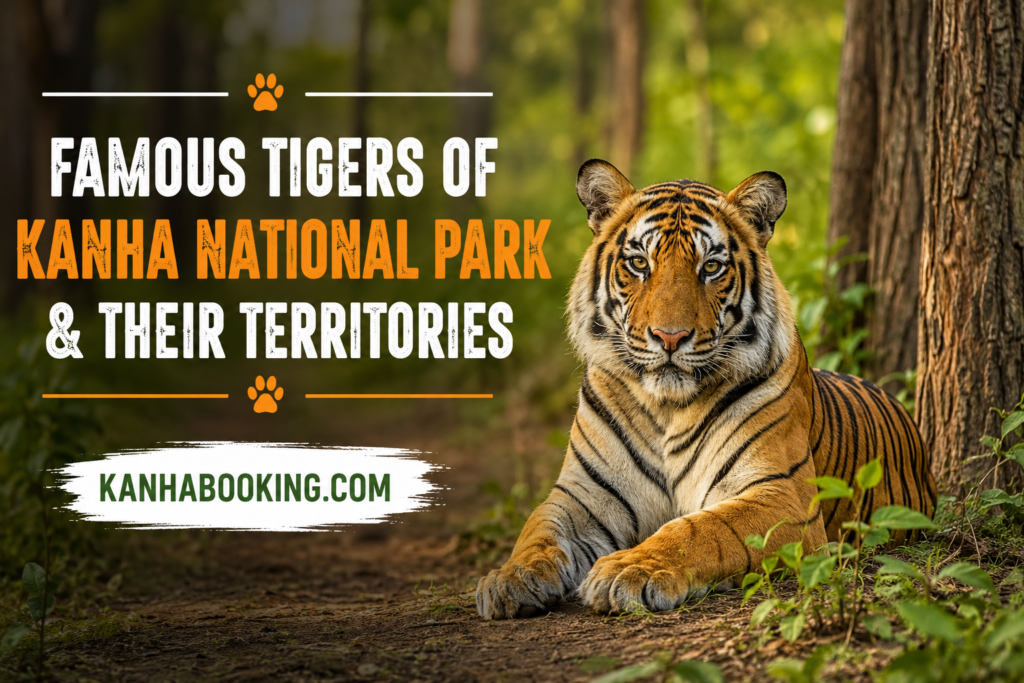
If you have ever dreamed of watching a Royal Bengal Tiger walk slowly through an open meadow with the golden morning light behind it, Kanha National Park is the place that actually delivers that moment. Kanha is not just any wildlife destination. It is one of India’s most storied tiger reserves, sitting deep in the forests of Madhya Pradesh, and it has given the world some of the most recognizable individual tigers ever documented.
What makes Kanha National Park special is that over the years, certain tigers have become known by name. Safari guides, naturalists, and people who come back often have formed real bonds with these animals. You will notice that each tiger stays in its own zone. It tends to move along certain meadow edges and forest paths. Over time, those who see them again and again start to recognize small differences in their habits. They talk about these tigers with a calm kind of pride, like they mean it. That is why a Kanha tiger safari feels different from just being on the road and taking a chance.
Here is a look at some of the most famous tigers and tigresses that have ruled the jungles of Kanha and the zones they call home.
Munna – The King of Kisli Zone
No story about the famous tigers of Kanha National Park is complete without Munna. Also known as T-17, he became one of the most photographed wild tigers in the entire world. His face carried a marking on the forehead that appeared to spell CAT, which made him instantly identifiable from photographs alone.
Munna ruled the Kisli zone for years and was known for his relaxed attitude around safari vehicles. Visitors came back season after season just to see him. He was dominant, confident, and rarely hid from people watching him. Forest naturalists describe his territory patrol as ceremonial in the way he moved through Bandri Behra and the surrounding grasslands with complete authority.
In his later years, Munna shifted toward buffer areas and was eventually moved to Bhopal Van Vihar for his own safety after he started moving closer to villages. His legacy in Kanha tiger conservation history is enormous and every guide in Kisli zone will speak his name with deep respect.
Neelam (T-65) – Queen of Kanha Meadows
Neelam is one of the most dominant tigresses active in the Kanha zone today. Born around mid-2013, she carries strong bloodlines from the legendary Munna through her lineage, which makes her both genetically impressive and behaviorally bold.
She holds the largest territory in the Kanha zone and has established herself as the undisputed queen of Kanha meadows. The open grasslands of the Kanha zone, which offer clear sightings of large animals, fall within her range. She is known for raising multiple litters and is among the most frequently spotted tigresses during Kanha jeep safari sessions in the Kanha zone.
Her territory overlaps in a few spots with the adjoining Naina’s range, and the two tigresses have had occasional skirmishes over these shared boundaries. Still, Neelam continues to hold the central meadow areas firmly.
Naina (T-76) – The Bold Tigress of Eye Contact
Naina is one of those rare tigers that actually looks back at you. While most tigers tolerate safari vehicles from a distance, Naina makes direct eye contact with observers far more often than other individuals. This is how she earned her name, which simply means eyes in Hindi.
She lives in the Kanha area that tourists often pass through. Because of that, regular visitors sometimes get a real shot at seeing her. People in the park talk about her as a striking tigress, both bold and very beautiful.
Her land overlaps with Neelam’s at times. It also overlaps with her mother, T-8. Watching how the three tigresses respond to this shared space is one of the more interesting behavior accounts in the Kanha tiger reserve.
If you book a Kanha jungle safari specifically in the Kanha zone, asking your naturalist about Naina’s recent movement is always a good starting point for planning your morning route.
Umarpani Male (T-30) – The Biggest Tiger of Mukki Zone
Umarpani Male T-30 is one of the largest male tigers ever recorded in Kanha National Park. Born in a litter of two cubs to the legendary Umarpani Female and sired by the iconic Munna (T-17), he carried remarkable genetics from both parents. He spent his early years in the Kanha zone tourism areas before establishing dominant control over the Mukki zone as an adult.
He defeated rivals including Rajaram in territorial fights and sired cubs with multiple tigresses including the Dhawajhandi female. His offspring, including T-27 and others, are still part of Kanha’s active tiger population today.
In January 2022, he survived two back-to-back territorial fights while severely injured and without any veterinary help. He recovered fully and returned to his territory eight weeks later. He eventually passed away near a sal tree after completing a final patrol of his kingdom, a true champion of Kanha tiger safari history.
Kankata – The Torn-Ear Male Who Fathered a Generation
Kankata’s name means torn ear in the local language, and he earned it through years of hard territorial battles. Born around 2003 in the Sarhi zone, he lived a remarkably mobile life compared to most dominant males. He moved from Sarhi to Mukki and extended his range into parts of the Kisli zone by around 2009.
What makes Kankata truly extraordinary is his breeding record. He mated with 8 to 10 different tigresses across these zones, making him the most prolific tiger in Kanha’s recorded history. His cubs include the bold Dhawajhandi female T-27, the large Sangam Male T-56 born from the old Indri female in 2009, and the shy Chimta female T-34 born to Choti Mada. His bloodline runs deep through Kanha’s current tiger population.
He was active in Kanha tiger reserve until around 2015, leaving behind a lasting genetic legacy across multiple safari zones.
Bheema – The Fighter of Mukki Zone
Bheema was a powerfully built male who controlled parts of the Mukki zone during his prime years between 2011 and 2016. Born to the Budbudi female, he was one of four cubs and grew up to become a formidable territorial male in the competitive southern zone of the park.
He fought hard against rivals including Chota Munna and the Umarpani male to control the hotly contested Mukki zone. His battles were legendary among safari guides who witnessed multiple territorial confrontations. Sadly, he suffered severe injuries in a territorial fight in 2016 and did not survive.
His story is a reminder of just how intense life is for a male tiger in a healthy, competitive population. Mukki zone is famous for exactly this kind of natural drama, and it remains one of the best zones for tiger sighting in Kanha today.
Chota Munna (T-29) – Son of a Legend
Chota Munna, son of the iconic Munna, carried his father’s reputation with attitude. He was known for his habit of walking confidently through tourist vehicles the way a person walks through a crowd, barely acknowledging the commotion around him.
He established himself in the Mukki zone and had several territorial contests with other males. His lineage and behavior made him a much-loved subject among wildlife photographers and repeat Kanha safari visitors. The Mukki zone during his active years was particularly exciting for guests who booked morning safaris specifically hoping to follow Chota Munna’s movement.
Sunaina – The Shy Mother of Kisli
Sunaina is a softer story in the list of famous Kanha tigers. Known for her shy and gentle temperament, she spent much of her time deep in the forested sections of her territory, away from open meadows and the usual tourist routes.
She became particularly notable when she was sighted moving through forested areas with three cubs, staying well away from zones where other tigers with overlapping territories might create conflict. Her maternal behavior and careful movement through the forest have made her a favorite among naturalists who follow the quieter, more patient side of tiger watching during Kanha gypsy safari sessions.
Sunaina occupies territory that borders both the buffer and core zones near Kisli, which means morning safaris from Khatia gate occasionally offer glimpses of her and her family.
FAQs
Munna (T-17) is the most famous tiger of Kanha, known worldwide for the CAT marking on his forehead and his long rule over the Kisli zone.
Umarpani Male T-30 is widely regarded as one of the largest male tigers ever documented in Kanha National Park.
Kankata means torn ear in the local language, a name he earned through years of territorial battles across Sarhi, Mukki, and Kisli zones.
Kankata mated with 8 to 10 different tigresses across multiple zones, making him the most prolific tiger in Kanha’s recorded history.
Mukki zone and Kanha zone offer the best tiger sighting chances. Munna ruled Kisli, while Umarpani Male and Kankata’s offspring dominate Mukki today.
Yes, Neelam T-65 remains one of the most frequently spotted tigresses in the Kanha zone and continues to hold her meadow territory.
Kankata’s known offspring include Dhawajhandi female T-27, Sangam Male T-56, and Chimta female T-34, all of whom established territories across Mukki and Kisli zones.
He recovered entirely on his own without any veterinary help, feeding near village edges until he regained enough strength to return to his core territory in Mukki zone.
The Kanha zone is ideal for spotting tigresses with cubs, as Neelam and Naina both raise litters within the open meadow tourism corridors there.
Conclusion
Kanha National Park is home to some of the most remarkable tigers ever documented in India. From Munna’s legendary rule over Kisli to Umarpani Male’s champion spirit in Mukki, from Kankata’s extraordinary breeding legacy to Neelam’s quiet dominance over Kanha meadows, every tiger here has a story worth knowing before you arrive.
Understanding these individual tigers makes your Kanha tiger safari far more meaningful than simply hoping for a sighting. You are not just watching a wild animal cross a forest trail. You are watching history walk.